Show Radon Transform is Continuous on Schwartz Space
In mathematics, Schwartz space is the function space of all functions whose derivatives are rapidly decreasing. This space has the important property that the Fourier transform is an automorphism on this space. This property enables one, by duality, to define the Fourier transform for elements in the dual space of , that is, for tempered distributions. A function in the Schwartz space is sometimes called a Schwartz function.


Schwartz space is named after French mathematician Laurent Schwartz.
Definition [edit]
Motivation [edit]
The idea behind the Schwartz space is to consider the set of all smooth functions on which decrease rapidly. This is encoded by considering all possible derivatives (with multi-index ) on a smooth complex-valued function and the supremum of all possible values of multiplied by any monomial and bounding them. This restriction is encoded as the inequality




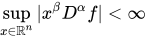
Notice if we only required the derivatives to be bounded, i.e.,
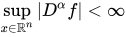
this would imply all possible derivatives of a smooth function must be bounded by some constant , so

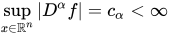
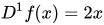
For example, the smooth complex-valued function with gives , which is an unbounded function, so any polynomial could not be in this space. But, if we require in addition the original inequality, then this result is even stronger because it implies the inequality



for any and some constant since


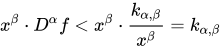
This demonstrates the growth of all derivatives of must be far lesser than the inverse of any monomial.

Definition [edit]
Let be the set of non-negative integers, and for any , let be the n-fold Cartesian product. The Schwartz space or space of rapidly decreasing functions on is the function space


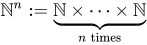

where is the function space of smooth functions from into , and


Here, denotes the supremum, and we use multi-index notation.

To put common language to this definition, one could consider a rapidly decreasing function as essentially a function f(x) such that f(x), f ′(x), f ′′(x), ... all exist everywhere on R and go to zero as x → ±∞ faster than any reciprocal power of x. In particular, S( R n , C ) is a subspace of the function space C ∞ ( R n , C ) of smooth functions from R n into C .
Examples of functions in the Schwartz space [edit]
Properties [edit]
Analytic properties [edit]
- From Leibniz's rule, it follows that 𝒮(R n ) is also closed under pointwise multiplication:
- If f, g ∈ 𝒮(R n ) then the product fg ∈ 𝒮(R n ).
- The Fourier transform is a linear isomorphism F:𝒮(R n ) → 𝒮(R n ).
- If f ∈ 𝒮(R) then f is uniformly continuous on R .
- 𝒮(R n ) is a distinguished locally convex Fréchet Schwartz TVS over the complex numbers.
- Both 𝒮(R n ) and its strong dual space are also:
- complete Hausdorff locally convex spaces,
- nuclear Montel spaces,
-
- It is known that in the dual space of any Montel space, a sequence converges in the strong dual topology if and only if it converges in the weak* topology,[1]
- Ultrabornological spaces,
- reflexive barrelled Mackey spaces.
Relation of Schwartz spaces with other topological vector spaces [edit]
- If 1 ≤ p ≤ ∞, then 𝒮(R n ) ⊂ L p (R n ).
- If 1 ≤ p < ∞, then 𝒮(R n ) is dense in L p (R n ).
- The space of all bump functions, C ∞
c (R n ), is included in 𝒮(R n ).
See also [edit]
- Bump function
- Schwartz–Bruhat function
- Nuclear space
References [edit]
- ^ Trèves 2006, pp. 351–359.
Sources [edit]
- Hörmander, L. (1990). The Analysis of Linear Partial Differential Operators I, (Distribution theory and Fourier Analysis) (2nd ed.). Berlin: Springer-Verlag. ISBN3-540-52343-X.
- Reed, M.; Simon, B. (1980). Methods of Modern Mathematical Physics: Functional Analysis I (Revised and enlarged ed.). San Diego: Academic Press. ISBN0-12-585050-6.
- Stein, Elias M.; Shakarchi, Rami (2003). Fourier Analysis: An Introduction (Princeton Lectures in Analysis I). Princeton: Princeton University Press. ISBN0-691-11384-X.
- Trèves, François (2006) [1967]. Topological Vector Spaces, Distributions and Kernels. Mineola, N.Y.: Dover Publications. ISBN978-0-486-45352-1. OCLC 853623322.
This article incorporates material from Space of rapidly decreasing functions on PlanetMath, which is licensed under the Creative Commons Attribution/Share-Alike License.
cunninghamhimpeas.blogspot.com
Source: https://en.wikipedia.org/wiki/Schwartz_space
0 Response to "Show Radon Transform is Continuous on Schwartz Space"
Post a Comment