Draw My Circle Tighter Fling Myself Further

Basic fighter maneuvers (BFM) are tactical movements performed past fighter shipping during air combat maneuvering (ACM, too called dogfighting), to proceeds a positional reward over the opponent. BFM combines the fundamentals of aerodynamic flight and the geometry of pursuit, with the physics of managing the aircraft's energy-to-mass ratio, chosen its specific free energy.
Maneuvers are used to gain a better angular position in relation to the opponent. They can exist offensive, to help an attacker gain an reward on an enemy; or defensive, to aid the defender evade an assailant'due south weapons. They can as well exist neutral, where both opponents strive for an offensive position or detachment maneuvers, to help an escape.
Classic maneuvers include the lag pursuit or yo-yo, which add distance when the attacker may overshoot the target due to higher airspeed, the low yo-yo, which does the opposite when the assaulter is flying too dull, the scissors, which attempts to drive the attacker in front of the defender, and the defensive spiral, which allows a defender to undo from an assaulter.
Situational awareness is often taught as the best tactical defense, removing the possibility of an attacker getting or remaining behind the pilot; even with speed, a fighter is open to assault from the rear.
Introduction [edit]
Basic fighter maneuvers (BFM) are deportment that a fighter aircraft makes during air combat maneuvering, historically known as dogfighting. The evolution of BFM began with the first fighter aircraft, during World War I, then continued with each post-obit war, adapting to the changing weapons and technologies.
Basic fighter maneuvers consist of many varying tactical turns, rolls, and other deportment to get behind or in a higher place an enemy, before the opponent can exercise the same. BFM are typically universal maneuvers which can be performed in almost any fighter aircraft, and are usually considered to be grooming maneuvers. Preparation usually begins with pilots flight the aforementioned type of aircraft, pitting only their skills confronting each other. In advanced grooming, pilots learn to fly against opponents in unlike types of shipping, so pilots must learn to cope with unlike technological advantages equally well, which more than resembles real combat. In actual air combat maneuvering, variations of these basic maneuvers may go necessary, depending on the different types of aircraft involved, the weapon systems each side is using, and the number of aircraft involved.[1]
BFM are used in the three-dimensional loonshit of air combat, where maneuvers are not limited by simple two-dimensional turns, such as during a car chase. BFM not only relies on an aircraft'due south turn performance, simply also on the airplane pilot's ability to make merchandise-offs between airspeed (kinetic free energy) and distance (potential energy) to maintain an energy level that will allow the fighter to continue maneuvering efficiently. BFM besides relies on the pilot'southward understanding of the geometry of pursuit within the iii-dimensional arena, where different angles of approach can cause unlike rates of closure. The fighter pilot uses these angles non merely to get within a range where weapons can be used, simply likewise to avoid overshooting, which consists either of flying out in forepart of the opponent, called a "wingline overshoot", or crossing the enemy's flight path, called a "flight path overshoot".
The fighter pilot with the most advantageous position is usually above or behind the opponent, and is unremarkably chosen the assailant. Conversely, the pilot in the disadvantageous position is commonly either below or alee of the opponent, and is referred to as the defender. Most maneuvers are offensive, such equally the "barrel roll attack", "high Yo-Yo", "low Yo-Yo", and "lag curlicue". Defensive maneuvers more frequently consist of turning very aggressively to avoid the attacker'due south guns, with maneuvers like the "pause" and the "loftier Yo-Yo defense"; sometimes tightening the plough, sometimes relaxing it, and other times reversing the plough. The defender volition usually maneuver to forcefulness an overshoot, or to extend the range enough to dive away and escape. However, other "last-ditch" maneuvers are used by the defender when the attacker achieves a firing solution, or the defender's free energy becomes depleted so that maximum plow operation cannot exist maintained, such as "guns defense" or the "defensive spiral".
History [edit]
Basic fighter maneuver development began during Globe War I, with maneuvers such as the "Immelmann", named later on High german pilot Max Immelmann, the "break" and the "barrel roll". The modern Immelmann differs from the original version, which is now chosen a stall turn or "Hammerhead turn". The Immelmann turn was an effective maneuver in the early office of the war but as aircraft technology advanced and fighter engines became more powerful, it became a dangerous maneuver, considering the opponent could climb and shoot the German fighters when they were almost motionless at the peak of the turn.[2]
Billy Bishop, the top Canadian ace of World War I, described a break:
Watching carefully over your shoulder and judging the moment he will open burn, y'all turn your car speedily so every bit to fly at right angles to him. His bullets volition generally pass behind you during the maneuver.[3]
During World War I, due to the low power of early aircraft, vertical movements were difficult and extended maneuvering led to a loss of energy. Combat tended to degenerate into private attacks, the classic "dogfights". 1 specific maneuver that did emerge was the defensive Lufbery, in which several allied aircraft would fly in a circle so that whatsoever attackers trying to position against 1 of the aircraft would fly direct in front of the shipping behind them.[4] As engines became more powerful, three-dimensional tactics became bachelor to counter the stalemate of the Lufbery, and by WWII it was no longer effective.[v]
Development continued through each war, as aircraft and weapon systems became more than avant-garde. Maneuvers such as the "combat spread" were first devised by pilots like Werner Molders during the Spanish ceremonious state of war.[six] A simple, non-turning course of the depression-Yo-Yo is depicted in John Godfrey's clarification of his first impale, flight a Republic P-47 Thunderbolt over Europe during Earth State of war II;
Breathlessly I watched the 109 in between the breaks in the clouds as I dove. At 12,000 anxiety I leveled off and watched him up ahead. In diving I had picked upwardly speed, and now had hitting 550 miles an hr. I was about 500 feet below him and closing fast. Quick at present, I've got time. I checked all around, in back and to a higher place me, to ensure that no other [Germans] were doing the same to me. My speed was slacking off at present, but I still had enough to pick up that extra 500 feet and position myself 200 yards dead astern. The 109 flew as direct as an arrow, with no weaving. As his plane filled my gunsight, I pressed the [trigger].[7]
Much of the modern energy-management techniques, which are used in maneuvers like the Yo-Yos, were only described scientifically after John R. Boyd developed his Energy-Maneuverability theory during the Vietnam War.[6] Still, as quoted by the U.S Navy Air Training Command, "1) The basics of ACM have not changed since the early days of aviation, and 2) A fighter pilot must maintain abiding aggressiveness for success. As the [Cherry-red] Baron would say, 'All else is rubbish.'".[8]
Training [edit]

Basic fighter maneuvers (BFM) are used by fighter pilots during a dogfight to proceeds a positional reward over an opponent. Pilots must have smashing noesis of not only their own aircraft's performance characteristics, merely also of the opponents, taking advantage of their ain strengths while exploiting the enemy'south weaknesses. Pilots demand proficient eyesight, state of affairs awareness, and the ability to maneuver confronting an opponent in three dimensions. BFM are generally grouped into ii categories:
- Primary BFM
- Relative BFM
Main maneuvers are those which are performed without respect to an enemy'south position. These are frequently unproblematic maneuvers, such equally climbs, turns, aileron rolls, slow rolls, and rudder rolls. Relative maneuvers are performed in relation to the motion of some other aircraft. These are oft more complex, including energy saving maneuvers, such equally the loftier and depression Yo-Yos, and repositioning maneuvers such equally displacement rolls.[nine] It is easy to fall into the trap of considering BFM to be a series of ready maneuvers providing a foolproof recipe for a ascendant position. The reality is that BFM are a serial of fluid and frequently improvised proactive and reactive deportment, varying infinitely according to range, altitude, speed, shipping blazon, weapons arrangement type and whatsoever of an enormous range of other factors. An extremely successful tactic one day may yield unfortunate results if repeated the adjacent day, and pilots often credit luck equally a major factor.[10]
BFM are ordinarily considered to be individual maneuvers, where ACM is applied to the tactics behind dogfighting equally a whole.[eleven] In military training, BFM are often conducted against an adversary in the same type of shipping. This allows the pilot to fly against a machine with known functioning values and allows aircrew to build their awareness of important concepts such as sight picture, rates of closure and line of sight rates that are cues to being successful in the visual loonshit. This also allows pilots to build their BFM skills against one another, without either having a particular technological advantage.
Dissimilar air combat training (DACT) consists of avant-garde maneuvers performed by aircraft of two separate types (such as F-16 vs F/A-xviii). This training is valuable in that both pilots are non as aware of the operation capabilities and characteristics of the other aircraft and, therefore, must rely on the fundamental BFM principles and evaluation/determination making skills to maneuver to an advantageous position versus their opponent. In this type of training, the advantages of ane blazon of fighter may differ profoundly from the advantages of the other, then pilots learn to refine their BFM skills to make apply of the opponent's weaknesses. Using BFM as the building blocks for multiple aircraft maneuvers, such as the finger four, loose deuce, and Thach weave, pilots acquire how to maneuver in situations involving one against one, one confronting two, ii against ii, two against many, or even one against many. This blazon of training, introduced during the last stages of flying schoolhouse, is more like bodily combat, and is the most beneficial for aircrew once basic BFM skills are mastered.
Principles [edit]
Specific free energy [edit]
Free energy is a principal cistron in decision-making and maneuvering an aircraft. If an attacker has too much energy, information technology may be easy to arrive range only hard to preclude an overshoot. Too piddling energy and the assaulter may non be able to go far range at all. If the defender has more than energy than the attacker, an escape may exist possible, but too little free energy and the defender will lose maneuverability.
In aviation, the term "energy" does not refer to the fuel nor the thrust it produces. Instead, thrust is referred to as "power". Energy is the state of the fighter's mass at any given fourth dimension, and is the issue of the power. Energy comes in ii forms, which are kinetic and potential. Kinetic energy is a function of the fighter'south mass and speed, while potential energy is a function of its mass, gravity and altitude. The combined potential and kinetic energy is called the total energy. Considering the energy package is the combination of mass, speed and altitude, a fighter flying at low altitude but a high speed may have the aforementioned total energy every bit a fighter of equal mass, merely flying at a depression speed and high altitude.
One of the inputs to the formula for total energy is the mass of the object, in this example the shipping. This means that two shipping flight under identical weather condition of speed and altitude volition accept different energy; the heavier aircraft will have higher free energy. Nonetheless, this does not imply that the heavier shipping volition exist more than maneuverable, equally that mass volition require more than energy to accelerate. For this reason, a more useful measure is the specific energy, the energy per unit of measurement weight. Lighter aircraft generally have higher specific energy for any given operational conditions.[12]
Free energy country can exist changed through the application of power. Heavier shipping will require more power to change their free energy state, so two aircraft with equal energy will not take the same maneuverability. This leads to the concept of "specific power" in the same fashion as specific energy. For any given operational status, a selected speed and distance for instance, any given aircraft will require a certain amount of ability but to maintain those conditions, due largely to the effects of drag. This gives rise to the concept of "specific excess power", the corporeality of boosted power available to an shipping over and above the power needed to maintain those flight conditions.[12]
Specific excess power is normally expressed for an shipping flying directly and level. Turning requires an expenditure of energy, both to change the energy country of the aircraft, equally well as due to the additional induced drag that is naturally created as a side effect of generating the lift force required to change direction.[xiii] This implies that an shipping with higher specific excess power has higher sustained maneuverability performance. This overall concept is known as "energy maneuverability".[12]
Maneuverability is not solely a factor of energy or specific ability, many other factors similar the efficiency of the fly planform at generating lift, or the load limits of the shipping, can limit the maneuverability in ways that are not directly related to weight and power. This gives different shipping very different types of operation nether various maneuvers. For instance, an aircraft with high thrust for weight may take high specific backlog power but yet suffer from very high induced drag during turns - this was very common on delta fly aircraft for instance[xiv] - in which instance it will attempt to avoid turns and instead apply climbs and dives to its advantage. Such aircraft are referred to every bit "energy fighters". Others, typically those with lower fly loading, may have less excess power but nevertheless be able to perform turns without losing as much free energy, and are referred to as "angles fighters"[15] or "dog-fighters".
When two aircraft meet in combat, they may take dissimilar energy states and free energy retention. Typically, the fighter with higher free energy and better retention volition brand an "energy move", similar a high yo-yo to maintain the energy reward, while the fighter at an energy disadvantage (angles fighter) will make an "angles move" such every bit a break turn, trying to utilise the opponent's energy to their own advantage.[16] [17]
Energy management [edit]
In combat, a airplane pilot is faced with a variety of limiting factors. Some limitations are constant, such as gravity, structural integrity, and thrust-to-weight ratio. Other limitations vary with speed and altitude, such every bit turn radius, turn rate, and the specific energy of the aircraft. The fighter pilot uses BFM to turn these limitations into tactical advantages.[18] A faster, heavier shipping may non be able to evade a more maneuverable aircraft in a turning battle, but can often cull to pause off the fight and escape by diving or using its thrust to provide a speed advantage. A lighter, more than maneuverable shipping can non normally choose to escape, but must employ its smaller turning radius at higher speeds to evade the attacker's guns, and to try to circle around backside the attacker.[19] [ page needed ]
BFM are a constant serial of trade-offs between these limitations to conserve the specific free energy state of the aircraft. Even if there is no great divergence betwixt the energy states of combating aircraft, there volition be as soon as the attacker accelerates to catch up with the defender. However, potential energy can hands exist traded for kinetic energy, so an aircraft with an altitude advantage can easily turn the potential free energy into speed. Instead of applying thrust, a pilot may employ gravity to provide a sudden increase in speed, by diving, at a cost in the potential free energy that was stored in the grade of distance. Similarly, past climbing the pilot tin use gravity to provide a subtract in speed, conserving the shipping'due south kinetic energy by irresolute it into distance. This tin can assist an assaulter to prevent an overshoot, while keeping the free energy available in case one does occur.[20]
Turn performance [edit]
Both turn rate (degrees per 2d), and plow radius (diameter of the turn), increase with speed, until the "corner speed" is reached. Corner speed is defined every bit the minimum speed at which the maximum sustainable m-force load can be generated (the load at which power equals elevate), and varies with the fighter'southward structural design, fly loading characteristics, weight (including added weight from missiles, drop-tanks, etc...), and thrust capabilities.[20] Information technology oft falls in the area of 250–400 kn (290–460 mph; 460–740 km/h).[19] The maximum sustainable-load the aircraft can generate also varies, but is typically between 3 and v chiliad'southward. At the corner speed, the fighter tin can attain its maximum turn-rate, flying the craft just at the border of buffeting (the turbulence preceding a stall). Below this speed, the aircraft will be limited to flying at lower g's, resulting in a subtract in plough charge per unit. If the pilot attempts to "pull" more chiliad'south, the aircraft will buffet and aerodynamically stall. On the other hand, if the fighter is flown above its corner speed it volition be able to pull higher g'due south, simply doing then will cause it to lose airspeed from the excess elevate created. Turning at the maximum sustainable-load at speeds in a higher place the corner speed will result in an increment in plough radius which, respectively, will crusade a decrease in plow charge per unit.[21]
"Instantaneous turn-charge per unit" describes turns which are in a higher place the maximum sustainable-load. These turns can be every bit loftier as 9 g'due south before the pilot begins to lose consciousness (G-LOC). These turns can have a very small turn radius, simply cause a loss in free energy, either in the form of speed or altitude. Therefore, these turns are unsustainable, causing the fighter to lose massive amounts of airspeed, sometimes reaching stall speed in as little equally a quarter turn. To some degree the free energy loss may be compensated for by increasing thrust, known every bit applying "excess specific ability", merely this cannot fully make up for the losses. This usually occurs during hard turns or even harder "breaks". But by turning the aircraft at its best "sustained turn-charge per unit" tin can the aircraft maintain its specific energy. However, situations in combat may require a change in energy, and energy may too exist increased by pulling less than the maximum sustained k-forcefulness load.[20]
Pursuit curves [edit]

Successful BFM requires geometry equally much as it does skill and stamina.[22] Pilots must know their shipping's corner speed, too as optimum angles of banking company (AOB) and angles of set on (AOA), without consciously thinking about them. At the same fourth dimension, pilots must remain conscious of the bending between the opponent'southward velocity vector and their own, called the track crossing angle (TCA), which is important when aligning or avoiding a firing solution. Most importantly, the airplane pilot must remain aware of the angle off tail (AOT), which is the angle between flying paths.[23] [24] [25] A high AOT causes a high rate of closure, but makes achieving a suitable guns solution nearly impossible. Acquiring a low AOT (getting on an enemy's tail), can decrease or even contrary closure charge per unit, and is unremarkably the master goal before an overshoot occurs. However, an uncooperative defender may attempt to take reward of the high closure rate by turning to increment AOT, forcing an overshoot.[22]
The AOT is often estimated past the position of the attacking aircraft'due south nose in relation to the defender. AOT are generally grouped into three categories, called "pursuit curves". "Lead pursuit" occurs when the olfactory organ of the attacker points alee of the defender, while "pure pursuit" happens when the aggressor's nose points directly at the defender. If the attacker'due south olfactory organ points behind the defender, the condition is known as "lag pursuit".[22]
Atomic number 82 pursuit [edit]
The master purpose for atomic number 82 pursuit is to provide closure, even when chasing a faster opponent. The high AOT presented during pb pursuit allows the aggressor to quickly decrease the forrad, lateral, and vertical separation between aircraft, simply by traveling a shorter path. Nevertheless, lead pursuit causes the AOT to increment at a rapid rate. This causes the closure rate to increment every bit well, and, in an attempt to prevent an overshoot, the attacker volition have to pull an increasingly tighter plough upon nearing the defender.[26]
An attacker in lead pursuit is well within the defender's rear view. Unless the defender has enough of a speed advantage to escape by relaxing the turn and dropping into a shallow dive, the defender will probable turn sharply in an attempt to increase the AOT, forcing the attacker to plough fifty-fifty harder, to overshoot, or to perform a maneuver out of the horizontal plane to compensate.[27]
Pb pursuit is used during gun attacks, because the fast movement of combat requires that the aircraft'southward cannons be aimed at a point in space alee of the defender, where the enemy volition be when the bullets arrive. This is called "leading the target". Lead pursuit presents the assaulter with difficulty in maintaining sight of the opponent, as the nose of the attacking aircraft becomes an obstruction to the pilot'southward view.[28]
Pure pursuit [edit]
Like lead pursuit, pure pursuit is used to provide closure. However, closure is not as rapid, nor is the charge per unit of increase in AOT. This is not equally effective against a faster moving opponent, so the attacker may need to accelerate to maintain pure pursuit. Pure pursuit is used when acquiring a missile lock. It both places the attacker further aft of the defender and presents the defender with the smallest amount of surface expanse to see. This complicates evasive action, since just the front of the attacking shipping is in view.[26] [29]
Lag pursuit [edit]

A Japanese A6M3 Zero in cold-side lag pursuit behind a US B-25 Mitchell.
Lag pursuit is used to stop or opposite closure rate and to decrease AOT, while allowing the attacker to maintain or increase forward separation (also called olfactory organ/tail separation, or nose-to-tail). Following outside the defender's turn radius, the assaulter can maintain or increase energy while forcing the defender to turn at an energy depleting rate.[26]
"Hot side" lag occurs when there is a large amount of forward separation between shipping, showing the top side of the defending fighter. This puts the attacker in the defender'south rear view, and the mutual defense is to tighten the plow. "Cold side" lag occurs when there is little nose-to-tail separation, leaving the belly of the defending fighter in view. This puts the assailant in the defender's blind spot, and the common defense is to contrary the turn. Unless the defender is markedly more maneuverable, and lateral separation is just correct, lag pursuit can non exist maintained for long, causing the AOT to decrease until a suitable firing solution is presented.[thirty]
Out-of-plane maneuvers [edit]
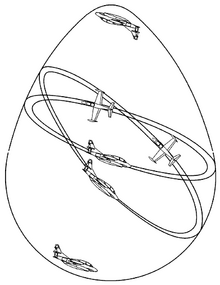
Maneuvering planes, showing oblique and vertical turns.
Maneuvers are rarely performed in the strictly vertical or horizontal planes. Nearly turns contain some caste of "pitch" or "slice". During a plow in an oblique plane, a pitch plough occurs when the aircraft'southward olfactory organ points above the horizon, causing an increase in altitude. A slice plow happens when the nose points below the horizon, causing a decrease in distance. The purpose is non only to brand the shipping harder for an enemy to runway, but also to increase or decrease speed while maintaining energy.[31]
An out-of-plane maneuver enhances this result, by diverting the fighter into a new airplane of travel. Increasing the pitch or piece tin rapidly provide a change in speed, which tin just equally quickly exist reversed past returning to the original plane of travel. Out-of-airplane maneuvers are not only used to provide a reduction in turn radius, merely likewise causes the fighter to fly a longer path in relation to the management of travel. A maneuver such as a high Yo-Yo is used to slow closure and to bring the fighter into lag pursuit, while a low Yo-Yo is used to increase closure and to bring the fighter into atomic number 82 pursuit.[32]
During an out-of-airplane maneuver, the attacker's nose no longer points at the defender. Instead, the shipping is rolled until its elevator vector (an imaginary line running vertically from the center of the aircraft, perpendicular to its wings), is aligned either ahead of, directly at, or behind the defender, using ringlet rate instead of plough rate to ready the proper pursuit curve. The aircraft's velocity vector (an imaginary line in the direction of motion) will exist pulled in the direction of the lift vector.[33]
Deportation rolls [edit]

Typical deportation curlicue
A useful type of out-of-plane maneuver employed to subtract AOT are various barrel rolls called deportation rolls, in club to shift the shipping laterally from its projected flight path onto a new flying path. By decision-making the curlicue charge per unit the pilot tin can command the degree of displacement.[34] An aggressor following a more maneuverable opponent may become stuck in lag pursuit (outside the defender'due south turn radius), unable to achieve a firing solution. By displacing the plow, the two aircraft'south flying paths will eventually cantankerous. The AOT volition then decrease until the nose of the attacker's aircraft points momentarily at the defender, and then ahead of the defender.[35] A displacement roll is a proficient tactic when ever a reduction in turn radius is needed, but a decrease in turn rate is immune.[34]
Positioning [edit]
At that place are three basic situations in air combat maneuvering requiring BFM to catechumen to a favorable result, which are neutral, offensive, and defensive. Most relative maneuvers can be grouped into ane of these three categories.
Neutral [edit]
Neutral positions generally occur when both opponents spot each other at the aforementioned time. Neither the pilot nor the opponent have the reward of surprise. Neither has the ability to indicate the nose of their aircraft at the opponent with sufficient range to utilise forward firing ordnance (missiles/guns) prior to the opponent presenting a threat of a similar fashion. Each is focused on converting to an offensive situation while forcing their opponent into a defensive.[36]
Offensive [edit]
An offensive position generally occurs when the pilot gets sight of the opponent first. With the advantage of surprise, the pilot tin can maneuver into a better position to attack the opponent, making information technology more hard for the enemy to evade the attack.[36] Common tactics include increasing altitude and attempting to place the fighter directly between the sunday and the opponent. This helps put the pilot in a dominant position, primarily concerned with prosecuting their advantage for a kill. An offensive position is more often than not divers as the power to become to a higher place or behind the enemy. The pilot is able to create an energy advantage, providing the ability to swoop down on the opponent and spray the area with bullets while using the speed to climb back to a safe altitude. The attacker also has an orientation-related advantage, existence able to printing the attack while avoiding the enemy's weapons.[37]
Defensive [edit]
A defensive position usually occurs when the pilot spots the attacker tardily. Usually beneath or ahead of the opponent, the pilot is in a weak position, primarily concerned with denying a shot to the opponent and converting to a neutral position. The secondary goal is either to escape or to achieve a dominant position. If the aggressor is at an energy disadvantage, the defender volition likely use the speed to undo, merely, if the assailant is moving much faster, the defender volition normally maneuver in order to force a dangerous overshoot. A unsafe overshoot happens when an attacker flies out in front of the defender, causing their roles to be reversed.[36]
Concepts [edit]

Turn circle geometry. Fifty-fifty though depicted as flying at the aforementioned turn rate and plough radius, closure occurs during lead pursuit so reverses during lag pursuit, with the greatest nose/tail separation at the moment the assaulter pulls atomic number 82.
Once an attacker gets behind a defender, there are three problems to solve in order to prosecute the impale. The assaulter must be able to go into the same geometric plane every bit the defender, get in range without overshooting, and be able to atomic number 82 the target. The defender will ordinarily turn aggressively to spoil the attacker's solution.[23]
Turn circle [edit]
Shipping turn in circular motions, following a circumference effectually a central point. The circumference is ofttimes referred to every bit the "bubble", while the central betoken is often called the "post". Whatever change in the g-force load on the aircraft causes a alter in the bubble's size also as a modify in plow radius, moving the post in relation to the fighter. Considering an aircraft turning at its maximum load cannot turn any tighter, any shipping located between such a fighter and its mail is momentarily prophylactic from attack. It is in this area where an attacking fighter will usually try to position itself.[38]
Once within the defender's bubble, the attacker will be in lead pursuit and may have an opportunity for a lucky "snapshot" hit. If the attacker can maneuver onto the defender's flight path before an overshoot occurs, the attacker will be able to finish or reverse closure rate. The most desirable position is, following the defender's flight path, a altitude equal to 1 plough radius backside the opponent. This position, from which the attacker will be able to safely maintain control of the fight, is termed the "control bespeak". The control point lies in the heart of an imaginary, cone-shaped area, called the "command zone", and it is within this zone that the attacker will take both sufficient time and range to react to the defender's countermeasures.[39]
Overshoots [edit]
During a dogfight, the term "overshoot" refers to situations in which the assaulter either crosses the enemy's flight path or passes the defender, catastrophe upward in front.
Passing the defender is referred to as a "wingline overshoot". Also called a "three-9 line overshoot" or a "dangerous overshoot", this occurs when an attacking shipping approaches also fast and accidentally crosses the defender's wingline (an imaginary line passing through the heart of the shipping at the 3 o-clock and ix o-clock positions). A wingline overshoot is usually referred to every bit "flying out in front" and causes "role reversal", putting the aggressor in range of the defender'south weapons, and the assaulter suddenly becomes the defender.[40]
When the attacker crosses the defender'due south flying path, the situation is chosen a "flying path overshoot". This happens when an attacker fails to control closure and crosses the defender's flying path from behind. Although not necessarily unsafe, information technology is possible for a flight path overshoot to cause the assailant to fly out in front of the defender. More often, however, information technology profoundly reduces the attacker's angular reward over the defender. Flight path overshoots are divided into 2 categories, called "command-zone overshoots" and "in-shut overshoots".[40]
A "control-zone overshoot" occurs when the aggressor crosses the defender's flight path from behind the front edge of the command zone. After a control-zone overshoot, the defender will go along turning in the same direction to retain the acquired angular advantage, trying to foreclose the assailant from getting a expert aim.[twoscore]
An '"in-close overshoot" happens when the attacker overshoots the defender's flight path ahead of the control zone. This gives the defender the opportunity to reverse the turn and mayhap to cause a wingline overshoot, allowing the defender to motility in behind the attacker and reverse their roles.[40] [41]
Circle flow [edit]

Shipping tin turn either towards or away from each other. How the opponent turns in relation to the other determines the flow of the fight. If two fighters run into head-on, they volition usually make a very close, neutral pass, chosen a "merge". Afterwards the laissez passer, both fighters may turn to engage. If the two fighters turn in the same management (i.e.: both turn to the north), they will be traveling toward each other forth the same turn circle. This type of engagement is known as "1-circumvolve period". If the shipping turn in contrary directions (east.g.: one turns north but the other turns south), they will movement away from each other, flying around to engage each other on dissever turn circles. This is called "two-circle period".[42]
One-circle flow will result in another merge, unless an angular advantage can be obtained. During i-circle period, the fighter with the smaller turn radius will have the advantage. Pilots will often pitch-upwardly out-of-plane while increasing thrust, to help minimize plow radius. Because it does not actually thing where the 2 fighters run into in the circumvolve, plough rate is of footling importance during ane circle flow. Therefore, it is often called a radius fight. An out-of-plane maneuver, such as a displacement ringlet, is a feasible choice for reducing plough radius.[42]
Ii-circle menstruation volition also result in another merge. In ii-circumvolve flow, plough radius is of lilliputian importance, because what matters is which fighter can get back to the merging place first. Two-circle menses is a turn charge per unit fight, and the angular reward unremarkably goes to the aircraft with the higher turn charge per unit at its corner speed. Pilots will often slice turn in social club to maximize their plough rate.
A 3rd option is called vertical flow, in which one or both fighters plough toward the vertical airplane. If both fighters go up or downwards, the fight becomes 1-circumvolve flow. If ane fighter goes up or downwardly, while the other turns horizontally, it is really a modified version of i-circle flow. However, if i fighter goes up while the other goes down, information technology becomes ii-circle menstruum.[43]
In both types of menstruum, the closest possible merge is desirable to keep the enemy at an athwart disadvantage. Although circle period is ofttimes described using neutral merges, the concept applies anytime two aircraft maneuver in relation to each other and the horizon. For instance, the "flat scissors" is an example of ane-circle flow, while the "rolling pair of scissors" is an example of two-circumvolve flow.[44] [45]
Maneuvers [edit]
Combat spread [edit]
The combat spread is the most bones of maneuvers used prior to engagement. A pair of attacking shipping will separate, oft past a distance of one mile horizontal past 1500 anxiety vertical. The fighter with the lower altitude becomes the defender, while the wingman flies above in "the perch" position. The defender will and then attempt to lure their opponents into a practiced position to be attacked past the wingman.[46]
Defensive divide [edit]
A pair of fighters encountering one or two attackers will often utilize a defensive split. The maneuver consists of both defenders making turns in opposite directions, forcing the attackers to follow only one shipping. This allows the other defender to circle effectually, and maneuver behind the attackers.[19]
Sandwich [edit]
A sandwich maneuver begins with two defenders flying line-abreast (side by side at the same distance), with typically about a mile of lateral separation. When an attacker maneuvers onto the tail of 1 aircraft, the defender will brand a sharp turn abroad from the wingman. At the same time, the wingman turns in the same direction every bit the defender. When both fighters turn 90 degrees, they will come up into unmarried-file alignment with each other, "sandwiching" the attacker in the eye. Because the assailant is distracted chasing the defender, this allows the wingman to maneuver onto the attacker's tail for an easy shot.[19]
Intermission [edit]
Spotting an assailant approaching from behind, the defender will ordinarily break. The maneuver consists of turning sharply across the assaulter's flight path, to increase AOT (bending off tail). The defender is exposed to the aggressor's guns for only a brief instant (snapshot). The maneuver works well because the slower moving defender has a smaller plow radius and bigger athwart velocity, and a target with a high crossing speed (where the bearing to the target is irresolute rapidly) is very hard to shoot. This can also help to force the assailant to overshoot, which may not be true had the turn been made away from the attacker's flight path.[nineteen]
Barrel coil set on [edit]

The counter to a break is often a displacement roll chosen a butt roll assault. A barrel scroll consists of performing a ringlet and a loop, completing both at the same time. The result is a helical gyre effectually a straight flight path. The barrel roll attack uses a much tighter loop than the roll, completing a full loop while only executing iii/4 of a roll. The effect is a virtual xc degree plough, using all three dimensions, in the direction opposite of the curl. Rolling away from the defender's pause, the attacker completes the roll with the aircraft's olfactory organ pointed in the management of the defender's travel.[19]
Loftier-side guns pass [edit]
If the attacker has a significant distance advantage, a high-side guns pass is usually prudent. Sometimes called a "swoop", "boom and zoom", "hitting and split", plus a diverseness of other names, it consists of a powered dive toward the rear quarter of a lower flying opponent. Shooting with the cannons in a single, high-speed pass, the attacker uses excess kinetic energy to undo from the fight in a zoom climb back to a safe altitude, restoring the potential energy. This allows the attacker to set up another attack and dive over again. Surprise is ofttimes a fundamental element in this type of attack, and the attackers will often hide in the sun or clouds, stalking their opponents until a good opportunity is presented. A high-side guns pass is a very constructive tactic confronting a more than maneuverable opponent, where the turning battle of a dogfight is best avoided.[47]
Immelmann [edit]

Schematic view of an Immelmann turn:
- Level flight
- Half loop
- 180° ringlet to bring aircraft back level
An Immelmann trades airspeed for distance during a 180 degree change in direction. The shipping performs the outset half of a loop, and when completely inverted, rolls to the upright position. The Immelmann is a good offensive maneuver for setting upward a high-side guns pass against a lower altitude, wearisome moving opponent, going in an opposite management. Notwithstanding, an Immelmann is a poor defensive maneuver, turning the defender into a tedious moving target.[48]
Split-Southward [edit]

Schematic view of a Split S:
- 180° scroll
- Half loop
- Exit level
The contrary of an Immelmann is the Split-S. This maneuver consists of rolling inverted and pulling back on the stick, diving the aircraft into a one-half loop, which changes the aircraft's direction 180 degrees. The carve up-s is rarely a viable option in combat as information technology depletes kinetic energy in a turn and potential energy in a dive. It is most often used to set up up a high-side guns pass confronting a lower merely fast moving opponent that is traveling in the opposite direction. Besides, the carve up-s is sometimes used as a detachment tactic.[48]
Pitchback [edit]

Chandelle from the FAA Publication FAA-H-8083-3A (Plane Flying Handbook)
A pitchback, as well chosen a Chandelle, is an Immelmann that is executed in some airplane other than the vertical. Basically but a pitch turn, the fighter will be at some angle of bank before performing the half loop and roll. Unlike the Immelmann, a pitchback depletes less kinetic energy and is harder for an adversary to track.[48]
Wingover [edit]
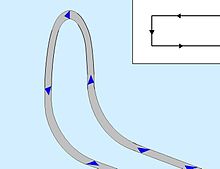
Diagram of a basic wingover
A wingover is a maneuver used to provide a fast, 180 caste turn with a very minor turn radius. Information technology consists of a quarter loop into a vertical climb, letting the speed autumn as altitude increases, and so a apartment-plow over the top, diving to complete a quarter loop at the original distance, merely going in the opposite direction. The wingover is like to a stall plough, simply the fighter does not actually stall, which makes the wingover more hard for an enemy to rail. Different an Immelmann or a split-s, the wingover also manages energy past conserving both airspeed and altitude.[49] [50]
Low Yo-Yo [edit]

The low Yo-Yo is one of the most useful maneuvers, which sacrifices distance for an instantaneous increase in speed. This maneuver is accomplished by rolling with the nose low into the turn, and dropping into a steeper piece turn. By utilizing some energy that was stored in the vertical plane, the aggressor can quickly subtract range and improve the angle of the attack, literally cut the corner on the opponent'southward turn. The pilot then pulls back on the stick, climbing back to the defender's height. This helps irksome the aircraft and prevents an overshoot, while placing the free energy back into distance. A defender spotting this maneuver may effort to accept reward of the increase in AOT by tightening the turn in guild to force an overshoot.[45] [48] The low Yo-Yo is oftentimes followed by a high Yo-Yo, to help prevent an overshoot, or several small low Yo-Yos tin can be used instead of one large maneuver.[51]
Loftier Yo-Yo [edit]
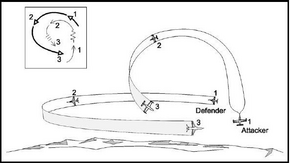
The high Yo-Yo is a very effective maneuver, and very difficult to counter. The maneuver is used to dull the arroyo of a fast moving aggressor while conserving the airspeed free energy. The maneuver is performed past reducing the bending at which the aircraft is cyberbanking during a plow, and pulling back on the stick, bringing the fighter up into a new airplane of travel. The assailant then rolls into a steeper pitch turn, climbing above the defender. The trade-off between airspeed and altitude provides the fighter with a burst of increased maneuverability. This allows the attacker to brand a smaller plow, correcting an overshoot, and to pull in backside the defender. Then, by returning to the defenders plane, the assailant restores the lost speed while maintaining energy.[32] [48] [52]
Lag displacement roll [edit]

A lag displacement roll, too called a "lag curlicue", is a maneuver used to reduce the angle off tail past bringing the attacker from lead pursuit to pure, or even lag pursuit. The maneuver is performed by rolling up and away from the turn, then, when the aircraft's lift vector is aligned with the defender, pulling back on the stick, bringing the fighter dorsum into the turn. This maneuver helps prevent an overshoot caused by the high AOT of lead pursuit, and tin can also be used to increase the distance between aircraft.[34] [48]
High Yo-Yo defence force [edit]
To prevent an overshoot, an attacker in lead pursuit may need to correct with an out-of-aeroplane maneuver. If the lateral separation is excessively high, the attacker will probably use a displacement roll. However, if the lateral separation is low enough, the assaulter will likely use a high Yo-Yo. The high Yo-Yo defense can be a expert tactic in these situations. The maneuver is performed when the attacker rolls away from the turn to begin the correction. The defender volition brainstorm to relax the turn by easing off of the stick, called "unloading", which causes both plow radius and speed to increase, restoring the fighter's lost energy. If the defender maintains the same angle of bank, the subtle maneuver volition be very difficult for the assaulter to spot. When the assailant completes the out-of-plane maneuver, the defending fighter has regained some of its free energy. This allows the defender to, once more, plough harder into the assail, regaining an angular advantage over the higher energy attacker. If the attacker is surprised by the maneuver, a loftier Yo-Yo defense might even crusade an overshoot.[53] [54]
Unloaded extension [edit]
An unloaded extension is a disengagement (bug out) maneuver often used by the pilot whenever there is enough energy and separation. The maneuver consists of slipping into a steep, straight dive and applying full thrust. Removing all yard-force load from the aircraft causes information technology to accelerate at a very loftier charge per unit, allowing the pilot to vastly increase range, or "extend", and possibly to escape.
If a defender breaks suddenly, causing the attacker to overshoot, the defender may reverse the turn and move in behind the attacker. An unloaded extension is commonly the attacker's best option, using the energy advantage to escape the slower moving defender. An unloaded extension is unremarkably not recommended confronting a higher energy opponent. However, in many circumstances, such as when an attacker performs a high Yo-Yo too steeply, an unloaded extension is a viable option for the defender.[32] [55]
Scissors [edit]
The pair of scissors are a series of plow reversals and flight path overshoots intended to boring the relative forrard motion (downrange travel) of the aircraft in an attempt to either forcefulness a dangerous overshoot, on the function of the defender, or prevent a dangerous overshoot on the assailant's part. The defender's goal is to stay out of phase with the attacker, trying to prevent a guns solution, while the attacker tries to go far stage with the defender. The advantage usually goes to the more than maneuverable shipping. There are two types of scissor maneuvers, called apartment pair of scissors and rolling scissors.[56]
Flat scissors [edit]

Flat scissors, also called horizontal scissors, usually occur after a low-speed overshoot in a horizontal direction. The defender reverses the turn, attempting to strength the assailant to fly out in front and to spoil aim. The attacker then reverses, trying to remain backside the defender, and the two aircraft begin a weaving flight pattern.[57]
Rolling scissors [edit]

Rolling scissors, likewise chosen vertical scissors, tend to happen later a high-speed overshoot from above. The defender reverses into a vertical climb and into a barrel roll over the acme, forcing the aggressor to attempt to follow. The advantage lies in the shipping that can pull its nose through the top or bottom of the turn faster. In battles with aircraft that have a thrust-to-weight ratio of less than ane the aircraft will quickly lose distance, and crashing into the ground becomes a possibility.[58] Co-ordinate to author Mike Spick, "Disengagement from a vertical rolling pair of scissors is best made with a split-s and a lot of hope."[59]
Guns defense [edit]
Guns defense maneuvering, or "guns-D", is the last resort for a defender that fails to outmaneuver the assaulter. Guns-D is a serial of random changes in the defenders flight path, intended to spoil the attacker'southward aim past presenting a constantly shifting target, and, hopefully, to maneuver out of the bullet stream (hose). It consists of capricious speed changes, yaws, skids, slips, pitch-ups, and rolls, and is oft referred to as "jinking". Considering the assailant must aim ahead of the opponent, the principal goal in guns-D is to disorient the attacker's aim by keeping the olfactory organ pointed in a different direction than the velocity vector (the direction of travel), and is very effective at preventing the attacker from achieving a suitable guns solution. However, guns-D maneuvering still leaves the defender susceptible to stray bullets and "lucky shot" hits, and does little to ameliorate the relative positional state of affairs. Thus, it is simply employed every bit a last-ditch defensive effort when nothing else works.[60]
High-g barrel roll [edit]

A high m butt whorl tin be performed over-the-top or underneath.
A high-thousand barrel roll is a combination of a loop and a snap roll. A high k barrel roll is a terminal-ditch defensive maneuver, performed when the attacker has accomplished a suitable guns solution, in society to cause an overshoot. The high-g butt roll is a vehement maneuver which is performed much more aggressively than a normal butt roll. Range is critical to the success of the curl, and the defender will usually plow very difficult, or employ other measures to draw the opponent very close earlier performing the roll. The roll is executed by applying hard dorsum-stick force per unit area, creating the high thousand-forces, and adding hard rudder input to assist the ailerons in rolling the fighter. A loftier-g butt scroll can be performed "over-the-top", or information technology can be performed "underneath", which is accomplished by rolling upside-down and commencement the maneuver from the inverted position. The high-g barrel curlicue is an energy-depleting maneuver that rarely causes the attacker to wing out in front end, merely usually will result in a flight path overshoot, a flat pair of scissors, or, at the very least, will temporarily disrupt the attacker'southward aim.[61]
Defensive spiral [edit]

A defender that fails to outmaneuver the aggressor can rapidly become "out of airspeed and ideas". The defensive spiral is a maneuver used by the defender when the kinetic energy becomes depleted and other last-ditch maneuvers can not successfully be implemented. The maneuver consists of dropping the nose low during the plow and going into a screw dive, using gravity to supply the free energy needed to continue evasive action. The defensive screw becomes a rolling scissors performed direct downwards. The defender'due south goal is to stay out of stage with the aggressor until the ground is dangerously close. The advantage ordinarily goes to the shipping that tin decelerate quicker, and the defender will often cut the power and extend the speedbrakes in an try to forcefulness an overshoot. If this attempt is unsuccessful, the defender will usually pull out of the swoop at the terminal possible 2nd, hoping to cause the assaulter to crash into the basis.[62]
See also [edit]
- Air combat maneuvering
References [edit]
Citations [edit]
- ^ Shaw, p. 11
- ^ Shaw, p. 154
- ^ Shaw, p. 25
- ^ United States Air Force Lexicon. United states Air Strength. 1956. p. 310.
- ^ U.S. Navy Air Training Command - Air combat maneuvering -- Rolling scissors Archived September xiii, 2012, at the Wayback Machine
- ^ a b Budiansky p. 6
- ^ Shaw, p. 15
- ^ U.Due south. Navy Air Training Command - Air combat maneuvering -- Introduction Archived December 29, 2013, at the Wayback Car
- ^ Shaw, p. 62
- ^ Shaw, p. x
- ^ Shaw, pp. x–xii
- ^ a b c Shaw 1985, p. 394.
- ^ Shaw 1985, p. 398.
- ^ The Delta Wing (PDF) (Technical report). Embry-Riddle Academy. p. 2. [ permanent dead link ]
- ^ Shaw 1985, p. 105.
- ^ Shaw 1985, pp. 141–179.
- ^ "Figure nine-six Specific Energy". Navyflightmanuals.tpub.com. Archived from the original on March 18, 2014. Retrieved March 18, 2014.
- ^ Variable Factors Archived June 5, 2011, at the Wayback Machine, Flight Training Instruction
- ^ a b c d e f Spick
- ^ a b c Corner Speed Archived June 5, 2011, at the Wayback Machine, Flight Training Instruction
- ^ U.S. Navy Air Grooming Command - Air gainsay maneuvering -- Full energy (TE) Archived December 29, 2013, at the Wayback Car
- ^ a b c Shaw, pp. 62–67
- ^ a b BFM Geometry Archived June five, 2011, at the Wayback Machine, Flight Training Education
- ^ T-45 Flight Manual Glossary of Terms
- ^ ACM Analysis
- ^ a b c Figure 9-11 Pb Pursuit Archived October 3, 2011, at the Wayback Automobile, Flight Training Instruction
- ^ Shaw, pp. 63–65
- ^ Shaw, pp. 7–x
- ^ Shaw, pp. 47–52,65
- ^ Shaw, pp. 65–67
- ^ Figure 9-3 Horizontal Maneuvering Archived June v, 2011, at the Wayback Machine, Flying Preparation Pedagogy
- ^ a b c Figure 10-14 Perch Position Archived December 23, 2010, at the Wayback Machine, Flying Preparation Didactics
- ^ Shaw, pp. 87
- ^ a b c Figure 10-sixteen Low Yo Yo Archived June 5, 2011, at the Wayback Machine, Flying Preparation Instruction
- ^ Shaw, pp. 67–71
- ^ a b c Spick, p. 146
- ^ Shaw, pp. 147–150
- ^ Figure 9-15 Turn Circle Archived October 3, 2011, at the Wayback Machine, Flight Grooming Instruction
- ^ Figure 9-17 Postal service-Bubble Archived October 3, 2011, at the Wayback Car, Flight Training Instruction
- ^ a b c d Basic Principles of BFM Archived August v, 2011, at the Wayback Machine
- ^ Fighter gainsay: tactics and maneuvering By Robert L. Shaw - United States Naval Institute 1985 Folio 67
- ^ a b Figure 10-21 One Circle Flow, Flight Training Instruction
- ^ U.South. Navy Air Training Command - Air combat maneuvering -- Engagements Archived March iv, 2016, at the Wayback Machine
- ^ Figure 10-22 1 Circumvolve = Radius Fight, Flight Training Instruction
- ^ a b "Affiliate x Low yo yo". FLIGHT TRAINING INSTRUCTION. NAVAL AIR Grooming Command. Archived from the original on June 5, 2011.
- ^ Figure 10-2 Combat Spread, Flying Grooming Instruction
- ^ Shaw, p. 294
- ^ a b c d eastward f Ill's ACM School: Maneuvers Explained Archived August 31, 2009, at the Wayback Machine. 352ndfightergroup.com. Retrieved on 2010-ten-23.
- ^ Mikoyan-Gurevich MiG-21 Pilot's Flying Operating Instructions By Nato -- 2008 Folio 120--121
- ^ Douglas A-1H Skyraider Pilot'south Flight Operating Instructions By United States Navy 2008 4-16
- ^ Shaw, p. 73
- ^ Shaw, pp. 71–73,294
- ^ High Yo Yo Defence, Flight Training Instruction
- ^ Shaw, p. 137
- ^ Shaw, pp. 134,185
- ^ Pair of scissors Maneuvering Archived June 5, 2011, at the Wayback Machine, Flight Preparation Instruction
- ^ Effigy x-18 Apartment Scissors, Flight Training Didactics
- ^ Chapter ten
- ^ Spick, p. 147
- ^ Valid Attack To Guns-D, Flight Training Education
- ^ "High-1000 Roll - P-12220045". Tpub.com. Archived from the original on August 27, 2009. Retrieved March 18, 2014.
- ^ "Final-Ditch Maneuvers". Tpub.com. Archived from the original on August 28, 2009. Retrieved March eighteen, 2014.
Bibliography [edit]
- Budiansky, Stephen (2004). Air power : the men, machines, and ideas that revolutionized war, from Kitty Militarist to Gulf War 2. New York, N.Y: Viking. ISBN978-0-670-03285-3.
- Shaw, Robert (1985). Fighter combat : tactics and maneuvering. Annapolis, Md: Naval Constitute Press. ISBN978-0-87021-059-four.
- Spick, Mick (1987). An illustrated guide to modern fighter combat. London: Salamander. ISBN978-0-86101-319-seven.
- Naval Air Training Command, NAS Corpus Christi, Texas (2006) Flight Training Instruction
External links [edit]
- Bones Fighter Manoeuvring Terminology Overview of BFM terminology at F-16.net.
cunninghamhimpeas.blogspot.com
Source: https://en.wikipedia.org/wiki/Basic_fighter_maneuvers
0 Response to "Draw My Circle Tighter Fling Myself Further"
Post a Comment