Renaissance Window Painting Venice Art Troops Returning Painting 16th Century
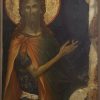
25. Paolo Veneziano and 14th century Veneto painters. Early Venetian painting is closely bound up with the traditions of Byzantium – and of the Paleologue empire in particular. Gradually, during the grade of the 14th century, information technology would become more open to the modern and Gothic influences coming from mainland Italia. Features characteristic of Central Italian, rather than Veneto-Byzantine, painting can already be seen in the Genealogy of Christ, with the Life of Christ and the Virgin , a work of complex symbolic content which, higher up all in the stories depicted in the right-manus console, reveal some influence of Giotto. A more directly link with the Byzantine tradition can be seen in the Madonna and Child, Pietà and Saints, and the Madonna and Child – works which nevertheless have a distinctly Veneto style and can be attributed to a Greco-Veneto artist of the fourteenth century. The Madonna and Child with Angels is, for its office, to be attributed to an early 15th century Cretan-Veneto artist, shut to the school of Andrea Rizzo of Candia; the attempt to render the throne in perspective, and the modelling of the figures of the Madonna and Child, are clearly Western-influenced and propose a link with the Veneto. A turning-betoken in painting inside the lagoon would come with Paolo Veneziano, the nearly important of early 14th century Venetian painters and 1 of the most significant figures in the Gothic art of the Po valley surface area.
He would develop his own very personal creative language, with a subtle balance between Byzantine and Gothic influences, fifty-fifty if in the latter part of his career his work might exist described as neo-Byzantine. It is to that later period that the two panels St. Augustine, St. Peter, and St. John the Baptist are to exist attributed. These are side panels of a now-dismembered polyptych from the parish church of Grisolera, near San Donà di Piave (the central panel was lost). The elongated figures remain faithful to Byzantine models, just the vivid colour, the richly-adorned vestments, and the creative person'south care in portraying individual figures with shrewd expressions and elegant movements, all signal the influence of Gothic art. These various influences within the artist's work tin besides be seen in the fragment of St. John the Baptist, part of a much larger composition that probably came from the Venetian cathedral of San Pietro di Castello; here, the clearly Byzantine confront goes together with a vivacity of colour and elegance of pose that are symptomatic of Gothic art. The painter of the St. Peter was conspicuously influenced past Paolo Veneziano, as ane can run into from the expressive modelling of the figure, whilst the St. John the Baptist painted within an aedicule reveals the influence of Lorenzo Veneziano, together with that of contemporary Tuscan fine art.
26. Lorenzo Veneziano. The virtually significant artist in Venice during the second half of the 14th century was Lorenzo Veneziano, who probably trained inside the studio of Paolo Veneziano. Whilst conspicuously receptive to the influence of his master, this artist would develop a more decidedly Gothic artistic language. But while responding to the painting of mainland Italia – especially that of the Po Valley expanse, where some echoes of Northern Europe might be felt – Lorenzo Veneziano also maintained the Byzantine tradition in works characterised past great elegance of line and hitting limpidity of palette. In the panel with Saints Julian (?), Mark, Bartholomew; three stories of St. Nicholas; the Saints Gabriel, Ursula and Lucy – the extant central part of a now-lost polyptych – he reveals his independent creative personality both in his use of color and in his limerick of the scenes (above all, in those regarding the life of St. Nicholas, which are characterised by groovy immediacy and vivacity). The frame, modelled on a three-lite Gothic window, is as well original for this catamenia. The panel of Jesus giving the Keys to St. Peter is dated 1369 by the Venetian calendar of the twenty-four hour period (that is, 1370), and was role of a polyptych, the predella panels of which (Life of St. Paul and St. Peter) are now in the Staatliche Museen in Berlin. Here, the creative person adopts a awe-inspiring composition, accentuating the space of the picture through the construction of the marble throne surrounded by angels and saints. The richness of Jesus' vestments and mantle, the latter creating a play of chiaroscuro as it falls in soft folds, vest to a clearly Gothic artistic language, in which one can see influences from the Po valley and Emilian regions. Recent cleaning has restored the fantabulous enamel-similar colour which is one of the unmistakable trademarks of the artist'southward work. The Crucifixion with Saints is the work of a Veneto-Byzantine artist and can be dated to the first decades of the 14th century; the respect for Byzantine iconographical models is hither relaxed a niggling in the everyday humanity of the faces – a conspicuously Venetian trait. The four panels with Saints John the Baptist, Paul, Peter, and Andrew were formerly attributed to the circumvolve of Lorenzo Veneziano, but now are attributed to his follower Jacobello di Bonomo, who is known to have been active in the catamenia 1375-1385.
27. Flamboyant Gothic. Gothic Fine art in Venice was to flourish long and successfully, particularly in the fields of domestic, public and religious architecture, playing a key role in establishing the layout and appearance of the city. Evidence of this is to be seen in two fragments of fresco decoration discovered during work on a house at San Giuliano, most St. Mark'south, in the early 1900s. Transferred to woods panels, these fresco fragments were then caused by the Museum every bit rare works that offer priceless evidence regarding the development of gustation and the layout of domestic interiors in 14th century Venice. They draw 4 allegorical figures of the Virtues: on one, Charity, Constancy, Hope; on the other, Temperance. Each with their identifying emblems and symbols, these sit within Flamboyant Gothic seats busy with aedicules and small statues. Though with articulate Venetian features – particularly in the palette used – the works reveal the presence of mainland influences that can exist traced to the Padua area. Though dating from an earlier era (late 13th and early 14th century), for conservation reasons the Catafalque of the Blessed Giuliana di Collalto is also on display in this room. Originally from the church of Santi Biagio east Cataldo on the Giudecca, this has a lid whose inner side is decorated with images of the saint, who died in 1262, and the ii saints after whom the monastery was named. Information technology is probably the work of a local artist, revealing a very Western attention to expression that clearly has piddling to exercise with Byzantine influences. The rather crude decorations on the front of the casket appointment from substantially later. The room besides contains a number of works of sculpture from this period: a fragment of a doorway from Palazzo Bernardo in the San Polo district, a fine Gothic marble transenna and 3 pinnacles in Istrian stone (probably part of an chantry, these reveal a French influence). Jacobello dalle Masegne'south small marble statue of Doge Antonio Venier is a niggling masterpiece by the creative person who was also responsible for the Iconostasis in St. Mark's Basilica. No generic representation of a public figure, the statue is a veritable portrait, revealing the inner strength and intensity of meditation of the sitter.
28. Gothic painting. Whilst still maintaining the severity of neo-Byzantine work, the numerous panel paintings by the artists who followed Lorenzo Veneziano reveal the influence of mainland Italy in various ways: their powerfully compact modelling, their monumentality, their affectionate interest in the natural world. Whilst the two figures of Christ on either side of the lobate Processional Cross are about conspicuously indebted to Byzantine models and the mosaics of St. Marker's, the artistic language of Lorenzo Veneziano certainly makes itself felt in the work of the "Master of the Madonna Giovannelli", whose Coronation of the Virgin nevertheless reveals more incisive brushstrokes in its cosmos of substantially corporeal figures. Neo-Byzantine features and Gothic influences appear together in the work of Federico Tedesco, represented here past the complex composition of the Allegory of Redemption and the altarpieces and compartments with St. John the Baptist, St. Paul, The Annunciation and (in the cyma), the Death of the Virgin.
His expressive immediacy and overall gentleness of tone mean that the bearding creative person known equally the "Master of the Correr Wall Panel" – afterward the work conserved in the museum – occupies a very special place in Venetian painting at the terminate of the 14th century. The Madonna with St. Paul and St. John is to be attributed to a Rimini artist, who is at present rightly identified with the and so-called Maestro dell'Arengo. Stefano Veneziano, Jacobello di Bonomo and Gothic Painters One particularly noteworthy figure amongst the artists working in Venice in the last decades of the 14th century was Stefano di Sant'Agnese, whose name indicates he was a plebanus – that is, parishioner – of the Venetian church dedicated to the saint. He stands out amidst the various artists of the day who offered a more than fluid form of the learned style developed by Paolo and Lorenzo Veneziano. The delicacy of course and elegance of line in his work reveal clear awareness of Gothic fine art, with some, timid, openness to the style of International Gothic. The rich decoration and architectural definition of the throne in his Madonna and Child – dated 1369 in the Venetian agenda (that is, 1370) – are certainly influenced past the piece of work of Paolo Veneziano, whilst the pyramidal composition of the figures and the naturalistic rendition of the gentle facial features seem to indicate a shut link with the painting of mainland Italy. Part of a polyptych originally in the Scuola dei Forneri [Bakers' Guild] almost the church of Madonna dell'Orto, his St. Christopher is the artist'due south last known work (1385) and reveals smashing vigour in the modelling of the effigy (iii other panels from that polyptych are at present in the church of San Zaccaria). An artist more closely bound to tradition was Jacobello di Bonomo, who is credited with ii panels here: Saints Peter and Andrew and Saints John the Baptist and Paul, which are from a much larger polyptych.
The elongated limbs and severity of the facial features (St. Peter and St. Paul virtually announced to be frowning) might exist taken every bit a return to Byzantine models; however, for all their monumentality, the figures are realistically modelled, and there are very refined decorative elements in the limerick.
29. The early 15th century. In the early on 15th century Venice, only uninteresting and out-of-touch artists who connected to take the Byzantine tradition as their model. The city'due south expansion onto the mainland was by this point leading to contacts with other Italian and European capitals and an important interchange of cultural influences. What is more, work on the Doge'southward Palaces was attracting such renowned artists as Gentile da Fabriano, Michelino da Besozzo and Pisanello, who made a key contribution in introducing International Gothic into the urban center. This was the cultural climate within which the double-sided panel painting of Affections Musicians (recto) and San Cosma (verso) was painted; information technology was probably the door of a triptych and is to be attributed to a follower of Michelino da Besozzo; whilst the painting of The Nascency inside a lozenge-motif frieze is the piece of work of an unknown artist, but does seem to reveal the influence of Jacobello da Fiore and Michele Giambono. Characteristic features of both these works are a taste for sumptuous and refined decoration, which sometimes results in the composition of complex abstract patterns. The influences to exist seen in the Venetian Francesco de Franceschi's small panels of the Martyrdom and Death of St. Mamante more than clearly herald the coming of the Renaissance. From a dismembered polyptych whose various parts tin now be seen in dissimilar collections, these works seem to echo the influence of both Giambono and Alvise Vivarini. International Gothic One of the most important exponents of the International Gothic schoolhouse of painting in Venice was Michele Giambono, who was not just a painter just likewise a mosaicist (he worked on the cartoons for the Madonna dei Mascoli chapel in St. Marker's Basilica). Especially influenced past the example of Gentile da Fabriano and Pisanello, he reveals himself in his Madonna and Child to be an creative person of elegant decorative compositions, whose refinement of palette has been further underscored by recent cleaning of this particular work. Some other important artist of the International Gothic school was Jacobello del Fiore, who in 1415 painted the Lion of St. Mark for the bounds of the Magistrato all Bestemmia [Blasphemy courtroom] in Palazzo Camerlenghi at Rialto, and in 1421 the Justice Triptych for the Magistrato del Proprio [Property, Dowry and Inheritance Court] at the Doge'southward Palace (the work at present hangs in the Accademia Gallery). The Madonna and Child hither is recognised equally one of the works about representative of the artist'due south style, its most hitting features being the handling of the light-blue curtain with arabesques of blue flowers and the use of rose-headed stamps to achieve a raised decorative effect along the hem of the gown and effectually the haloes. Yet, it is the gentle, aristocratic reserve in the mode the Virgin embraces the Child that reveals most clearly the influence of courtly Gothic – and of the piece of work of Gentile da Fabriano in item. Two works that are useful in a comparison betwixt the International Gothic of Venice and that of Central Italian are the Saint Ermagora and Saint Fortunatus. The side panels of a triptych (the central Madonna and Kid is now in a private collection in Paris), these are the work of Matteo Giovanetti of Viterbo, an assistant to Simone Martini who would really take over from his master in the work on the decoration of the Papal Palace in Avignon. The "Principal of the Jarves' Coffers", a Tuscan artist of the first half of the fifteenth century, is credited with the ii coffer panels (cl. I, 516) with the Story of Alatiel, inspired by Boccaccio's Decameron.

thirty. Cosmè Tura. One of the most influential artistic figures in Ferrara during the middle and late periods of the 15th century was Cosmè Tura, whose very personal fashion combined the main artistic influences at work in the metropolis: the monumentality of Piero della Francesca, the archaeological learning that was such a part of the Padua School (Tura may have stayed in that city in the mid 1450s) and the North European taste for colour to be seen in the work of Rogier van der Weyden (some of whose paintings were owned by Lionello d'Este, Lord of Ferrara). Critics universally recognise that the Correr Pietà is one of the artist's most significant works, both in terms of style and of limerick, fully exemplifying all the painter'south monumentality in spite of the reduced size of the picture (which would suggest it was intended as a private devotional image). The iconography is to be linked with High german Vesperbilder, sculptural groups of the expressionless Christ in the lap of his mother which were associated with the Vespers of Good Friday (and thus with the Liturgy of the Passion). X-ray examination carried out during restoration work a few years agone revealed the existence of an uncommonly high-quality and detailed preparatory sketch for this intense poetic paradigm of enormous pathos. The Portrait of a Man is to be attributed to a painter very close to Tura; in one case over again, the incisive and authentic details reveal the influence of the Flemish Schoolhouse.
31. The Ferrara School. The artists of the 15th century Ferrara Schoolhouse had an of import influence on the development of Venetian artists of the time, and the Teodoro Correr collection contains significant examples of their work. Antonio Leonelli da Crevalcore was a Bolognese-built-in member of the Ferrara School, and it was probably he who painted the Portrait of a Fellow, with the effigy shown in dazzling colours within a frame of polychrome marble and set against a green drapery which is partially pulled back to reveal a view of a coastal metropolis; the presence of the prayer book with the ring and pearl have led some to contend this was 1 part of a spousal relationship diptych. Whatever the truth, this is a piece of work in which incisive portraiture goes together with miniaturist precision in the rendition of the landscape. Similar incisiveness tin be seen in the Portrait of a Adult female. The work of a mid-century Ferrara School artist – perhaps Angelo Maccagnino (Angelo di Pietro da Siena) – this clearly reveals the influence of Pisanello's portraits. Another painting that can be attributed to the Ferrara School is the Death of St. Jerome; a work of ethereal atmosphere, this originally went together with some other two modest panels paintings (now in the Brera) from the Venetian Scuola della Carità. Padua was another artistic middle that was a fundamental point of reference for Venetian painters, who were influenced by the innovations in the work of Squarcione and his circle, and – to a higher place all – past the example of Andrea Mantegna.
The Flagellation is by a follower of Mantegna, Pietro da Vicenza, whilst the Madonna and Child – restored to its original splendour of colour by recent restoration – is the work of Giorgio Chiulinovich, known as Lo Schiavone [The Dalmatian], who trained nether Squarcione. The influence of that artist – together with that of the Tuscan School as represented past Piero della Francesca – tin be seen in the work of the Verona-born Francesco Benaglio, whose Madonna and Kid seen against a wide hilly landscape combines the example of della Francesca with a much more incisive, graphic use of line.

Bartolomeo Vivarini and Leonardo Boldrini With Bartolomeo Vivarini – who produced a number of works with his brother, Antonio – ane comes to what may be described as Venetian painting proper. Maintaining a very active studio in the city for a number of years, Bartolomeo Vivarini was one of the leading figures in that shift inside Venetian painting from Belatedly Gothic to Early on Renaissance. Receptive to innovations that Mantegna and the followers of Squarcione had introduced in Padua, Vivarini would – whilst preserving the erstwhile notion of a aureate background – give a very modern rendition of such a traditional theme as the Madonna and Child. There are ii fine examples of such works in the Correr; though the former has an extensively repainted background, in both of them the faces are remarkably gentle, with a hint of restrained sorrow. The Murano-born Leonardo Boldrini would train under Vivarini, merely also show himself open up to the influence of Lazzaro Bastiani and Giovanni Bellini. Bartolomeo Vivarini, even so, seems to be the master influence in his Madonna with St. Jerome and St. Augustine, in which the figure of the Virgin actually seems to be taken whole from Bartolomeo's Ca' Morosini polyptych, at present in the Accademia Gallery. The two later panel paintings – The Nativity and The Presentation in the Temple – have a sharpness of perspective that reveals the clear influence of Bastiani.
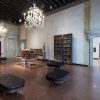
32. The 4 Doors Room. This is ane of the very few rooms in the Procuratie Nuove that has retained intact its original structure, dating from the late 16th and early 17th century. The just improver to Scamozzi'south original pattern are the 2 side doors (at present bricked in), which probably appointment from the 18th century – every bit practice the two large Murano chandeliers. The room is furnished with sixteenth- and seventeenth-century furniture and chairs and some examples of fifteenth-century wooden sculpture.

33. 15th century Flemish painters. The museum possesses a large collection of Flemish paintings, most of them acquired within the city during the nineteenth century past Teodoro Correr – further proof of the close relations that had existed between Venice and Northern Europe over the course of the centuries.
1 work that stands out is The Adoration of the Magi by Pieter Brueghel the Younger. This is one of a series of works in which the younger artist took his inspiration from a painting of the aforementioned bailiwick past his father, Pieter Brueghel the Older (now in a private drove in Winterthur), introducing a number of variations into his own versions of the work. X-ray studies during contempo restoration work revealed the presence of a very detailed preparatory drawing for this minutely-analytical piece of work, in which the miniaturist rendition of detail is so complete that some can merely exist seen with the aid of a magnifying-glass. This same, typically Flemish, attention to minute detail can be seen in a number of other works, whose artists are yet to identified with certainty. Peculiarly significant paintings include the Madonna and Kid – which is tentatively attributed to Dieric Bouts – and the ii doors with The Annunciation (recto) and St. Zaccaria (?) and St. Joseph (verso), recently attributed to a Flemish creative person active around 1490.
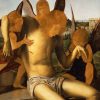
34. Antonello da Messina. Antonello da Messina arrived in Venice in the winter of 1474-75, staying at that place until the fall of 1476. Venetian documents record his presence in the city and his relations with the nobleman Pietro Buon, who commissioned from him the big altarpiece for San Cassiano (parts of which are now in the Vienna Kunsthistorishes Museum). The artist was to exist a decisive influence on the emergence of the keen Renaissance Schoolhouse of Venetian painting. From his work, which combined both Tuscan and Flemish influences, Venetian artists would seem to have learnt the technique of oil painting (though in that location are yet some doubts on this matter) and as well the correct application of perspective; and, for his part, from his stay in the city, Antonello caused a new interest in color, which would enrich and modernise his own artistic linguistic communication. The Pietà is the only piece of work left in Venice to bear witness to the creative person's presence in the metropolis. Equally source documents indicate, information technology was originally hung in the Sleeping room of the Council of Ten in the Doge's Palace, and although it has suffered impairment and mutilation at the hands of past restorers, it still maintains the charm and power of Antonello's art. It is also interesting to notation that though the subject of the Pietà was often explored by Mantegna and Bellini, this is the only known version of the theme painted by Antonello da Messina. The landscape behind the figures is particularly interesting, incorporating as it does the Messina church of San Francesco. Two other masterpieces in this room bear witness to the artist'due south shut links with contemporary Flemish painting: Hugo van der Goes' Crucifixion, a work that combines sobriety with intense dramatic power, and Dieric Bouts' Madonna and Child, in which the small crown of pearls symbolises the virgin birth and the coral the future sacrifice of Christ (further indicated by what looks like a small shroud).
35. Flemish and German painters. The paintings in this room are past Flemish and German artists active between the terminate of the fifteenth and the middle of the 16th century. The panel with The Revels of the Prodigal Son has recently been attributed to the circumvolve of the Flemish artist Paul Coeck. The scene is set outside an tavern, as one tin run across from the inn-sign fixed to a tree – on which wagers have been marked upwardly – and the glasses of wine and the fruit on the table. An Antwerp-built-in follower of Bosch is credited with The Temptations of St. Anthony, which is, in effect, a pastiche of Hieronymus Bosch'due south ain paintings of the subject. The various allegorical components in the piece of work include the huge man head with the gaping mouth, the group of nude figures, and the gold- and silverware beingness offered by the devil; respectively, these symbolise the gaping gateway to Hell, the temptations of the flesh, and those of vanity and riches. The Adoration of the Magi, around 1529, is attributed to an unknown German language artist; contempo cleaning has restored the original colours of the work. And the Lucas Cranach signature on painting of The Resurrected Christ is apocryphal; the work is probably to be attributed to one of his followers. The refined portraiture of the German artist Barthel Bruyn the Elder is very articulate in hisPortrait of a Gentlewoman; the elegance of the gown and the opulence of the jewels and the girdle – articulate indications of the sitter's social status – are deliberately counterbalanced by the skull, which indicates the ephemeral nature of worldly possessions. The two panels with St. Barbara and St. Catherine (collection of the Accademia Gallery) are part of a polyptych by Jos Amman von Ravensburg (Giusto d'Alemagna), the various parts of which are now to be seen in Venice, Modena and Lüttich. The creative person – a native of Ravensburg, which lies between Lake Constance and the Upper Rhine – is also known to have worked in Genoa, where his presence is documented in 1451. The Nativity and the Presentation in the Temple are once more parts of a dismembered polyptych – this time past Rueland Frueauf, whilst the Virgin and Kid with Choir of Angels is by the German artist Hans Chips.
It is the fundamental function of an altarpiece, the side panels of which are also part of the museum's collection.
36. The Bellini Family. The Bellini family provided some of the most of import Venetian painters of the 15th century: the male parent, Jacopo Bellini, and his two sons, Gentile and Giovanni. Afterward training under Gentile da Fabriano, who was in Venice from 1408 to 1414 to paint the history frescoes in the Bedchamber of the Slap-up Council within the Doge's Palace – Jacopo Bellini would so follow his master to Brescia and Florence; the latter urban center played an important part in exposing him to the climate of the Early Renaissance. The Crucifixion, of around 1450, is considered to be part of a predella from a polyptych (perhaps in the monastery of San Zaccaria) which too included the Adoration of the Magi and Christ's Descent into Hell (now in the Ferrara Pinacoteca Nazionale and the Padua Museo Civico respectively). The composition here is traditional: in the eye is Christ on the Cross, to his correct, Mary supported by the holy women (with a group of soldiers in the background), and to the left, a sorrowful St. John the Evangelist and the kneeling figure of Longinus recognising that this surely was the Son of God.
The low horizon isolates the figure of Christ against the heaven, lifting him above the actions and sorrow of those present. Jacopo'south elder son, Gentile, was the painter of the Portrait of Doge Giovanni Mocenigo (cl. I, 16), which though unfinished is one of the nigh important extant demonstrations of his skill equally a portrait creative person (a skill then renowned that, in 1479, Gentile was included as part of a Venetian diplomatic mission to Constantinople, where he painted the Portrait of Sultan Mehmet Ii which now hangs in the National Gallery, London).
Though an easily recognisable likeness, this portrait – taken in profile – does not strive to render the physiological individuality of the sitter himself; information technology is the Doge – the very symbol of the Venetian Republic – who is being depicted. Jacopo's younger son, Giovanni, would boss the world of Venetian painting in the 2d one-half of the fifteenth century.
Having trained under his father, he presently established himself as an independent artist, at the head of a very busy studio which would continue to be active until around 1515. Receptive to the lessons to be learnt from his brother-in-law, Andrea Mantegna, and influenced by the work of Antonello da Messina, Giovanni would develop a very refined – and in some ways, erudite – creative language. The Crucifixion (cl. I, 28) of 1453-55 belongs to the early stages of the creative person's career. In that location is a sharp break between the minutely-detailed background landscape and the foreground occupied by the drama of Christ's cede on the Cross, here read as an historical event to exist ready within daily life.
The influence of Mantegna is clear in the modelling of the figures, which achieve a certain monumentality in spite of the reduced size of the panel (the calibration of the piece of work suggests that it was painted as a individual devotional image).
Around the same time, the creative person painted the Pietà (cl. I, 39), the atmospheric composition of which echoes that to exist seen in a bronze bas-relief of the same subject that Donatello produced for the High Altar of the Basilica del Santo in Padua around 1447–48. The Transfiguration of Christ tin also be dated effectually the same time. Damaged in the upper section, this depiction of Christ on Mount Tabor was probably the altarpiece in i of two Venetian churches: San Salvatore or San Giobbe.
The Madonna and Kid – also known equally the Frizioni Madonna, after the owner who donated the piece of work to the museum in 1919 – dates from around 1470–75. Though transfer from panel to canvas has damaged the painting, and the sky has been repainted, the work is fine instance of Giovanni Bellini'due south inventive creativity: no other work of the time depicted the Virgin in this way, with a purple gown, a pink mantle and a veil – only half roofing her head – held in identify by a brooch. The Christ Child she is holding seems lost in thought every bit he rests his feet on a parapet, which symbolises non simply the sarcophagus in which He will be cached merely also the altar on which His death and resurrection will be celebrated in the Mass. The two modest paintings with Portrait of a Young Saint crowned with Laurel and Doge Pietro Orseolo and Dogaressa Felicita Malipiero are to be attributed to Giovanni's studio; the latter is the sole extant fragment of the predella of a polyptych originally painted for the church of San Giovanni Battista on the Giudecca. All of these works by the Bellini family unit have undergone recent restoration; and 10-ray examination carried out as part of that procedure revealed the presence of detailed preliminary sketches underneath each.
37. Alvise Vivarini and his time. Various contemporaries of Giovanni Bellini were well-aware of the lessons to be learnt from his work and yet developed their own art independently. The easel-work St. Anthony of Padua – in its original frame – is by Alvise Vivarini, son of Antonio and grandson of Bartolomeo, hence the last member of a family dynasty of painters which played such an of import role in introducing the artistic languages of Mantegna and the Padua School into Venice. A piece of work of refined and elegant line and very delicate palette, this painting is the artist'due south copy of part of some other of his works – the polyptych which at present hangs in the Accademia Gallery. In his Sacra Conversazione – signed and dated 1498 – Giovanni di Martino of Udine appears to exist an artist who was very close to Alvise Vivarini; whilst Benedetto Diana and Pietro Duia – represented here past a Pietà, Madonna and Kid, 2 Saints and Donors and Madonna and Child – would seem to have been much closer to the Bellini circumvolve. The influence of Alvise Vivarini tin can too be seen in the piece of work of Jacopo da Valenza, who worked largely in the surface area of Belluno, where he was born; he is represented here past The Madonna suckling the Child – signed and dated 1488 – and Madonna worshipping the Christ Kid. Though damaged, Cima da Conegliano's Madonna and Child with St Nicholas and St. Lawrence – dating from the second decade of the 16th century – reveals the creative person's atmospheric handling of book and his bright, enamel-like palette. The modest Madonna and Child with Angels – with its intensely spiritual, meditative figures fix against a gentle, rolling landscape – is by Lorenzo Lotto. Most refined in palette, the painting can be dated effectually 1525. Bartolomeo Montagna was a Vicenza-born creative person whose main influences were Giovanni Bellini and Antonello da Messina. He is to be attributed with the Santa Giustina – whose rather rigid composition too reveals the influence of Vivarini – and the after Madonna and Child with St. Joseph, with robustly-modelled figures and vivid surfaces of colour. Marco Basaiti's Madonna and Kid with Donor is universally held to exist an early work. The creative person would work with Alvise Vivarini for a number of years and the influence of the older painter is very articulate here – to a higher place all, in the brilliant, enamel-like palette.

38. Vittore Carpaccio. The Two Venetian Gentlewomen is one of the almost famous works by Vittore Carpaccio, the groovy Venetian painter of narrative cycles, famous for his St. Ursula Bicycle (now in the Accademia Gallery), the episodes in the lives of St. George, St. Tryphon, St. Jerome and St. Augustine (yet in the Scuola San Giorgio degli Schiavoni for which they were painted) and the St. Stephen Cycle (now split up between various galleries in Italia, Germany and French republic). In the past, Romantic art criticism had given this painting the title The Two Courtesans, merely the sitters are conspicuously ii gentlewomen, whose elegant garments and hairstyles clearly announce their wealth, their status – and their honesty. With regard to this last point, the virtue of the two ladies is underlined by various symbolic details: the pearls effectually the cervix of the younger woman indicate rigorous respect of marriage vows (as well as social condition), whilst the snow-white kerchief is a certain sign of purity. Similarly, the doves, the peahen and the dogs are, respectively, symbolic of modesty, marital concord, fidelity and vigilance (the concluding further guaranteed by the presence of the older woman, perhaps the female parent or elder sister of her companion, whom she resembles) What is more than, the vase of myrtle and the orange were constitute motifs that were traditional associated with the Virgin Mary (and the coat-of-arms on the vase is clearly that of an old Venetian family, the Preli). Details of costume make information technology possible to date this infrequent painting around 1490-95. The work has been cut beyond the top, and that missing part is present identified with panel-painting of A Scene of Hunting in the Lagoon (Paul Getty Museum, Los Angeles), in the lower section of which appears the lily which emerges from the vase with the coat-of-arms. Hence the subject-matter of the unabridged moving picture becomes clearer, with two noblewomen becoming mayhap slightly bored equally they wait for their husbands to return from a hunting trip. The St. Peter Martyr is a late work by Carpaccio. The polyptych of which it was office was originally in the Venetian church of Santa Fosca, but was broken up during the suppression of religious houses ordered by Napoleon; ii parts, St. Roch and St. Sebastian (the latter signed and dated 1514) are now to seen in the Bergamo Accademia Carrara and the Zagabria Academy respectively.
39. Carpaccio and the pocket-sized artists of the 16th century. But recently has the Madonna, Child and St. John the Baptist been identified with certainty as an early piece of work by Vittore Carpaccio; in the past it was considered a after copy of a work (now in the Frankfurt Sädelsches Kunstinstitut) whose attribution to Carpaccio has never been questioned. In spite of the all-encompassing damage to the work, recent restoration – fabricated possible past the contribution of Save Venice Inc. – has brought out the great quality of the painting, and x-ray examination has revealed some changes between the original sketch and the final work. Probably this is a piece of work which, before the Napoleonic suppression of religious houses, was in the monastery of San Giacomo. The Gentleman in a Red Beret, painted between 1490 and 1495, has recently been attributed to an creative person of the Bologna/Ferrara area. This high-quality work has, over the years, been attributed past critics to a number of artists – fifty-fifty Carpaccio himself (with reservations) – simply it is the article of clothing which supports the claim in favour of a Bologna/Ferrara artist: the short cloak, jerkin and, in a higher place all, the beret, were no part of the contemporary Venetian wardrobe. Lazzaro Bastiani was an artist who studied under –and collaborated with – Gentile Bellini, whilst besides existence open to the influence of Antonello da Messina. He is represented here by the triptych of Madonna and Child with Annunciation with a rather schematic background mural; his studio is to be credited with The Visitation. Various artists represented in this room gravitated effectually the Bellini circumvolve: Vincenzo da Treviso, known as Dai Destri, whose Presentation of Jesus in the Temple is derived from a Bellini original; Marco Marziale, who himself proclaims his debt to Giovanni Bellini in his Circumcision of Christ, dated 1499; and Marco Palmezzano, whose Christ with the Cantankerous and Saints is derived from a limerick that was often used by the Bellini studio. Giovanni Mansueto was a pupil of Gentile Bellini, and his St. Martin and the Beggar reveals a certain crudity of composition; whilst Pasqualino Veneto is an artist of whom we accept lilliputian information and few extant works, but he was probably a follower of Cima da Conegliano. His Madonna and Child with Mary Magdalene, signed and dated 1496, has a rather cold blue-dominated palette.
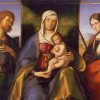
40. Artists of the Bellini circle. A native of Bergamo, Gerolamo Santacroce worked in Venice, where he had a studio. A collaborator of Giovanni Bellini's he never forgot his primary'southward example throughout the class of his long career. Other important influences on this rather eclectic artist were Cima da Conegliano, Lorenzo Lotto, Carpaccio and Giorgione. The Madonna and St. Joseph is from a larger limerick that must have depicted a Nascency. Hither, the softness of tone and gentleness of touch reveal the influence of Giorgione. Gerolamo's son, Francesco Santacroce, would continue in his father'southward footsteps. His Vision of St. Jerome is based on a work past Parmigianino, whilst his Madonna and Child, St. John the Baptist and Two Angels is nevertheless conspicuously 15th century in fashion, with a certain coldness of palette in the landscape. The Madonna and Kid with Santa Giustina and St. John the Baptist and the Madonna and Child are by Boccaccio Boccaccino, a Ferrara-built-in painter who worked mainly in Cremona; his creative person language reveals traces of Bellini, Cima da Conegliano and the fine art of Lower Lombardy. The room also contains iii works of 16th century sculpture: the bronze Bust of a Immature Man, probably past Andrea Ricco; the marble Bust of Carlo Zen by Giovanni Dalmata; and the Tombstone of Marcantonio Sabellico, produced by the workshop of Pietro Lombardo. The brandish-cases comprise French, Venetian and High german works in ivory dating from the 16th and 17th centuries.
41.Greek painters of Madonnas in Venice. Venice had ever had close links with the Eastern Mediterranean. The presence of the Venetian Republic as a political power in Cyprus, Candia and the Peloponnese clearly encouraged cultural interchange, and a big number of then-called Madonneri – Greek painters of iconic madonnas – would open up studios in the city, producing works in which the archaic traditions of Byzantine art were combined with influences from the most innovative of Venetian painting. Domenico Theotocopoli, better known as El Greco, trained as an artist in Venice. Open initially to the influence of Titian and then to that of Tintoretto, he is certainly the most famous of this group of Greek artists and is represented here by ii early works: The Last Supper and St. Augustine in Prayer with the Virgin and Christ on the Cross. Giovanni Permeniate, a Greek working in Venice towards the end of the seventeenth century, painted The Virgin Enthroned between St. John the Baptist and St. Augustine (?); his only signed work, it shows how the Byzantine tradition could be wedded to influences from 16th century Venetian painting. Emanuele Zane of Candia was another Greek creative person working in 17th century Venice. A priest at the church of San Giorgio dei Greci, he painted the St. Spiridion, to the sides of which are scenes from the life and miraculous works of the saint. Teodoro Pulakis was working in Venice from 1648, and was the artist of two signed paintings united in a single panel – King David Espies the "Shunammite" Woman Bathing and The Nativity – in which the luminescence of the palette is enhanced with touches of gold. The Cretan-born Michele Damaskinos worked in Venice and the Veneto in the second half of the seventeenth century; perchance he is the artist of The Wedlock Feast of Cana, a free copy of the Tintoretto work that hangs in the Sacristy of the church building of Santa Maria della Salute.
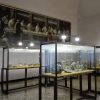
42. 15th and 16th century Majolica. The important works of Renaissance Italian ceramics on brandish in this room are intended to provide an overview of the various schools of ceramic-ware represented in the museum collection. The large basin with Neptune on a Seahorse was produced in Pesaro, whilst the display-case to the left contains various examples of Urbino ceramics, including a fruit dish with grotesques and a primal decoration showing The Three Graces. Moving rightwards, there are works past Maestro Giorgio Andreoli of Gubbio: a small tondo with armorial bearings (signed on the back) and a sweet dish decorated with a Bosom of Alexander the Slap-up. The next showcases contain works from Casteldurante and Venice, including a tile with a portrait of Doge Tommaso Mocenigo (attributed to Maestro Domenico) and the big jug decorated with Peleus and Thetis. The 2nd showcase along the archway wall and the one opposite it contain works by Orazio and Flaminio Fontana, ceramicists who worked in Casteldurante and Urbino; the outstanding pieces include Flaminio's plate with The Judgement of Paris and two guastada (flasks with flattened bodies) by Orazio, decorated with the Four Cardinal Virtues.
Then come works from Faenza – including the large tile which is dated and decorated with the Rape of Helen – and ceramic-ware by Nicola da Urbino. The following cases are dedicated to Francesco Xante Avelli, who was born in Rovigo and worked in Urbino from 1530 onwards; his works here include a series of plates decorated with mythological subjects and the guastada with The Death of Psyche. The canvas above the door is The Supper of St. Dominic past Leandro Bassano and dates from the end of the 16th century.
43. The Library. The walls of this room are lined with elm-wood bookcases dating from the 2d half of the 18th century; designed in 2 classical-inspired architectural orders, they were originally located in Palazzo Manin on the Thousand Canal. The antique books are of various provenance and periods. The, typically Gothic way, bronze lectern in the grade of an eagle is probably of English origin and dates from the end of the 15th century. Information technology comes from the Monastery of San Giovanni eastward Paolo. The Bust of Tomasso Rangone prepare between the windows is to exist attributed to Alessandro Vittoria. The imposing 18th-century Murano drinking glass chandelier is also noteworthy.
cunninghamhimpeas.blogspot.com
Source: https://correr.visitmuve.it/en/il-museo/layout-and-collections/second-floor/
0 Response to "Renaissance Window Painting Venice Art Troops Returning Painting 16th Century"
Post a Comment