Read Multiple Sheets at Once Goolesheets in R
Let's say you have a Google Sheets doc with multiple sheets that have the aforementioned structure (number and names of columns). You need to combine data from these sheets into i primary overview. Are you going to re-create and paste values manually? No manner! In Google Sheets, at that place are versatile options to automate the menstruation and forget most handwork. In this tutorial, we'll introduce several functions, as well as a formula-free solution, to merge sheets into one.
Combine data from 2 and more sheets within a single Google Sheets certificate
Let'southward begin with a uncomplicated task:
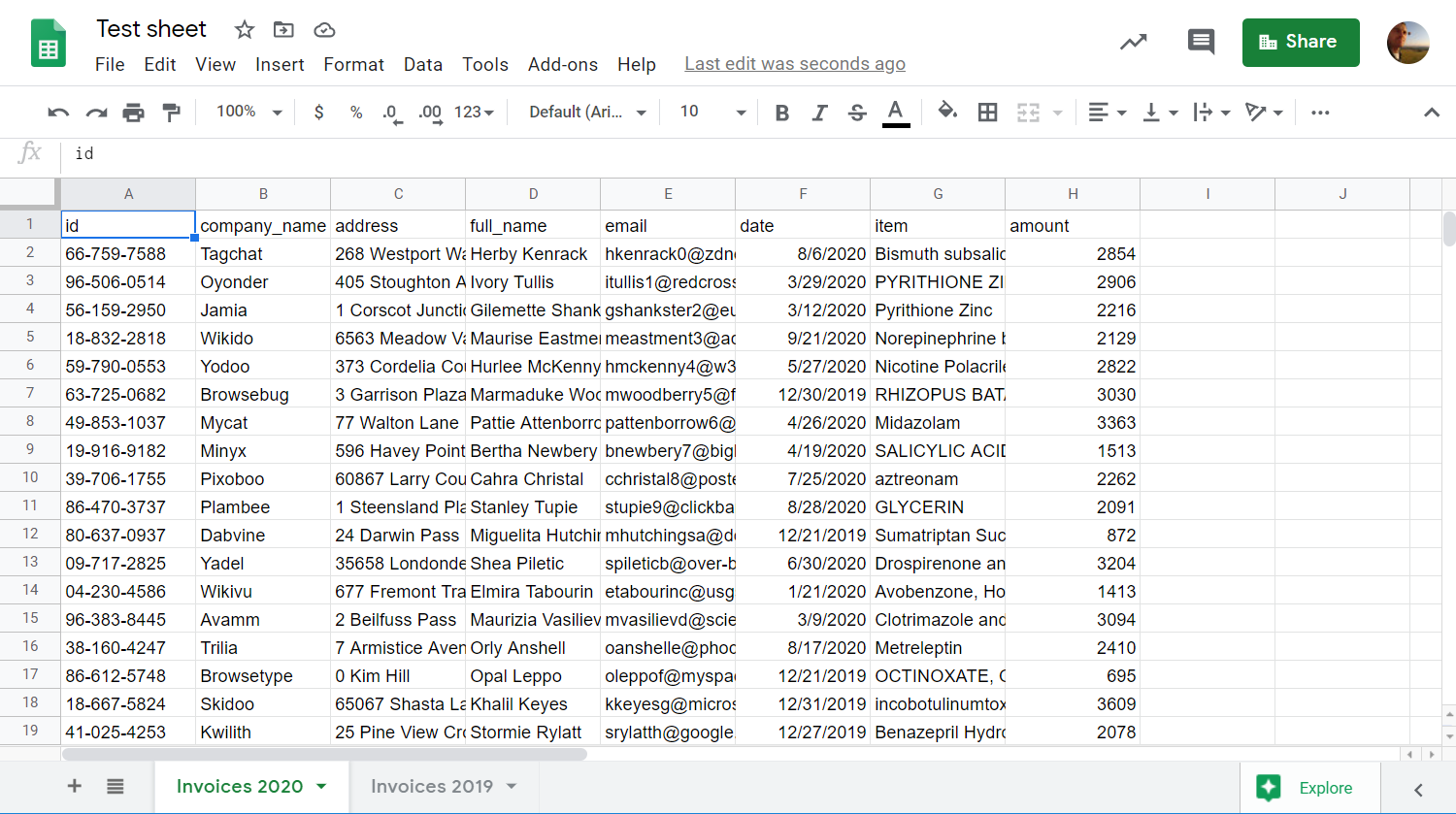
There is a Google Sheets doc with two sheets: Invoices 2019 and Invoices 2020. Each of these sheets has eight columns (A:H) of the same name. The first row contains the column titles. Our chore is to merge data vertically from these sheets into one.
Combine sheets into one with FILTER
FILTER is a Google Sheets function to filter out subsets of information from a specified information range past a provided status.
To combine sheets using FILTER, apply the post-obit formula:
={FILTER({sail#1-range},LEN({sheet#1-range-first-column})>0); FILTER({sail#ii-range},LEN({sheet#two-range-start-cavalcade})>0);...} -
{sheet#1-range}– the information range from the first sheet including the title row. -
{sheet#2-range}– the data range from the second sheet without the title row. -
{canvass#one-range-beginning-cavalcade}– the showtime column of the data range from the kickoff sheet. -
{sheet#2-range-first-column}– the beginning column (without the title row) of the data range from the second sheet.
The LEN condition (LEN({sail#one-range-first-cavalcade})>0) in the FILTER formula is required to skip empty rows in the range. Otherwise, the formula will likewise add together empty rows when merging the rows with data.
In our case, the formula will expect as follows:
={ FILTER('Invoices 2019'!A1:H, LEN('Invoices 2019'!A1:A) > 0); FILTER('Invoices 2020'!A2:H, LEN('Invoices 2020'!A2:A) > 0) } 
In this way, yous can merge more than than two sheets together. All you need is to add relevant sheets and their ranges in the formula.
Note: Make sure to specify the data range from the second sheet (and subsequent ones) without the championship row like A2:H instead of A1:H . Otherwise, the championship row will also exist imported. For instance,
={ FILTER('Invoices 2019'!A1:H, LEN('Invoices 2019'!A1:A) > 0); FILTER('Invoices 2020'!A1:H, LEN('Invoices 2020'!A1:A) > 0) } 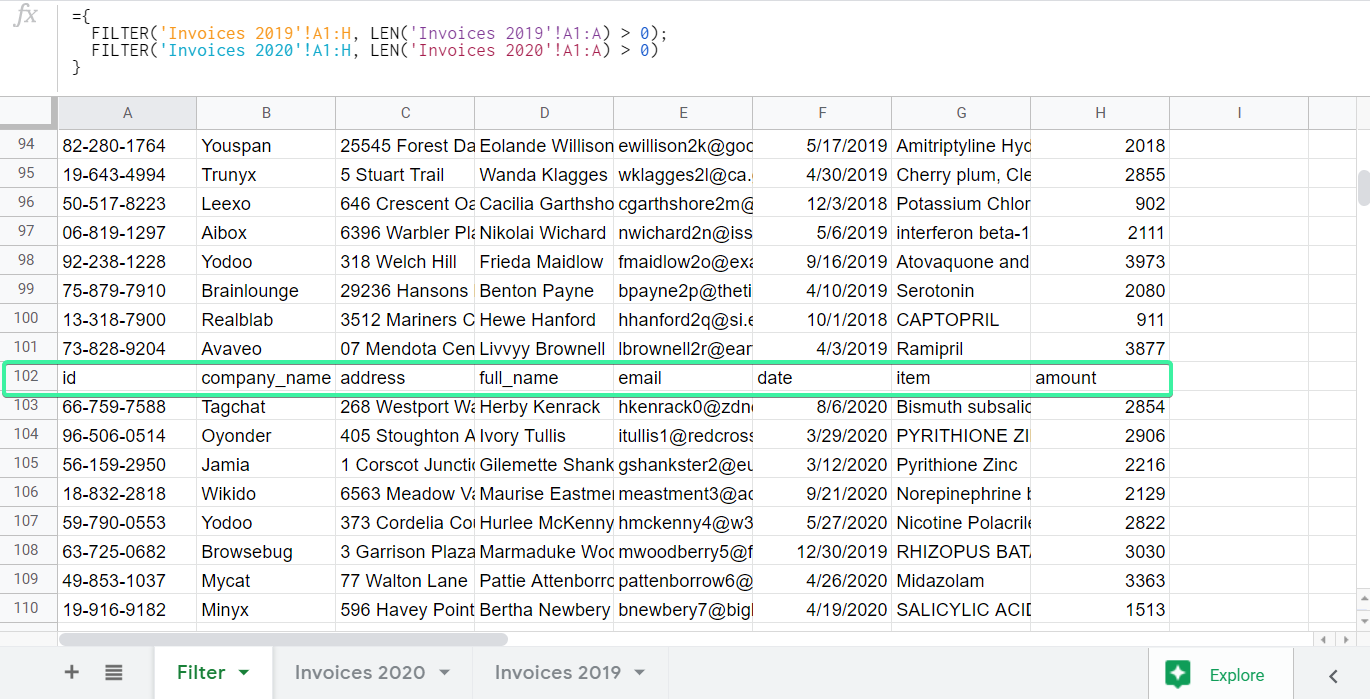
For more on how it works, read this FILTER Part How-to Guide.
Combine sheets into one with QUERY
QUERY is a Google Sheets function to fetch the data based on specified criteria. Additionally, you tin amend formatting, modify the lodge of columns, and perform other manipulations with the imported data.
To combine sheets using QUERY, apply the following formula:
=QUERY({{canvas#1-range};{sheet#2-range};...,"Select * where Col1 is not naught") -
{sheet#1-range}– the data range from the first sheet including the championship row. -
{sheet#2-range}– the data range from the second sheet without the title row.
In our case, the formula will look as follows:
=query({'Invoices 2019'!A1:H;'Invoices 2020'!A2:H},"Select * where Col1 is not null") 
Yous tin merge more than than ii sheets together with QUERY if y'all add together relevant sheets and their ranges in the formula. Don't forget that the ranges from the second and subsequent sheets should be specified without the title row just like with the FILTER role to a higher place.
Listen that the mentioned QUERY and FILTER formulas merge sheets with the aforementioned number of columns only. For other cases, read our guide on How To Combine Sheets With a Different Number of Columns Into Ane.
Combine sheets into 1 and consolidate data with QUERY
We've successfully combined sheets with invoices data. However, information technology would be great if we could not only merge, but also consolidate specific data from those sheets. For example, the invoice amount of the Abatz company in 2022 is $1778, and was $2864 in 2019. The Abatz's total invoice amount is $4642.
Our goal is to consolidate the invoice corporeality for all companies that have records in both sheets. For this, we've modified the QUERY formula above to get the post-obit:
=query({'Invoices 2019'!A1:H;'Invoices 2020'!A2:H},"Select Col2,sum(Col8) where Col1 is not cypher group past Col2") 
Since company_name is the just iterative parameter for which nosotros are consolidating data, we do not need to query other columns from the sheets.
Read the QUERY How-To Guide to learn more.
Merge sheets into 1 on a custom schedule
If you demand to combine multiple sheets into i automatically on a custom schedule, or yous only don't want to deal with formulas, use the Google Sheets importer. It allows y'all to import a information range from multiple sheets and merge them together.
Google Sheets importer is a office of Coupler.io, a product to import data from unlike data sources to Google Sheets, Excel, or BigQuery.
Coupler.io is available as a spider web app and a Google Sheets add-on, the latter needs to be installed from the Google Workspace Marketplace.

To set a Google Sheets importer, sign up to Coupler.io, click "Add new importer" and prepare source, destination, and schedule.
Source
- Select Google Sheets every bit a source app from the list.
- Connect your Google account or choose one from the driblet-down list if you've already connected some.
- Select a Google Sheets file on your Google Drive to transfer data from.
- Select sheets to merge.
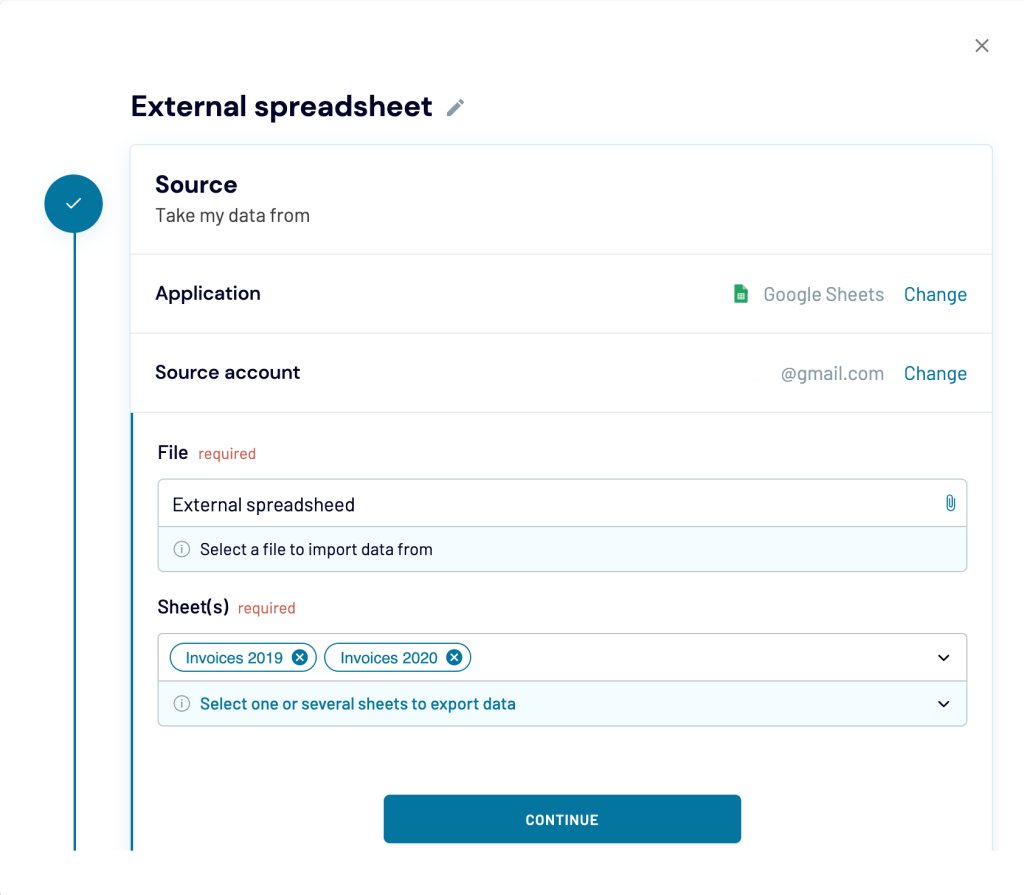
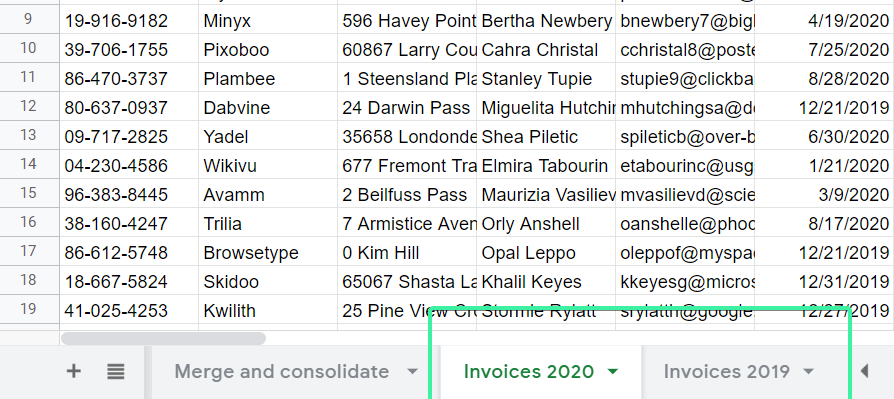
The gild of the sheets specified doesn't influence the club of the merged data. If y'all demand to merge data in a specific order (for example, get-go Invoices 2020, then Invoices 2019), make sure to arrange the sheets in your spreadsheet in this gild.
Merge sheets with a patterned name
You can merge multiple sheets that have a patterned name! Allow's say you take sheets with invoices for the last 10 years. Instead of typing in all them one by i (Invoices 2010,Invoices 2011,Invoices 2012, etc.), use the post-obit pattern:
{sheet-proper noun}.+
In our case, information technology will wait as follows:
Invoices twenty.+
This fashion the sheet names will be matched by pattern and if new sheets are added (Invoices 2021,Invoices 2022…), the data from them will exist merged automatically without irresolute the importer parameters.
The feature works similarly with any sheet names you have.
- Click "Jump to Destination Settings". Optionally, you can choose a specific range in your spreadsheets to merge. To practice this, click "Proceed" and specify the range in the optional field.
Destination
- Option Google Sheets as the destination application you want to save data to.
- Connect to your Google business relationship.
- Choose a Google Sheets file, which will receive the combined sheets.
- Specify the first cell where you desire to import your information range. The A1 cell is ready by default.
- Cull the import mode for your data: you can replace your previous information or append new rows under the concluding imported entries.
- Toggle on the Last updated cavalcade feature, if y'all desire to add a column to the spreadsheet with the data about the last date and time refresh.
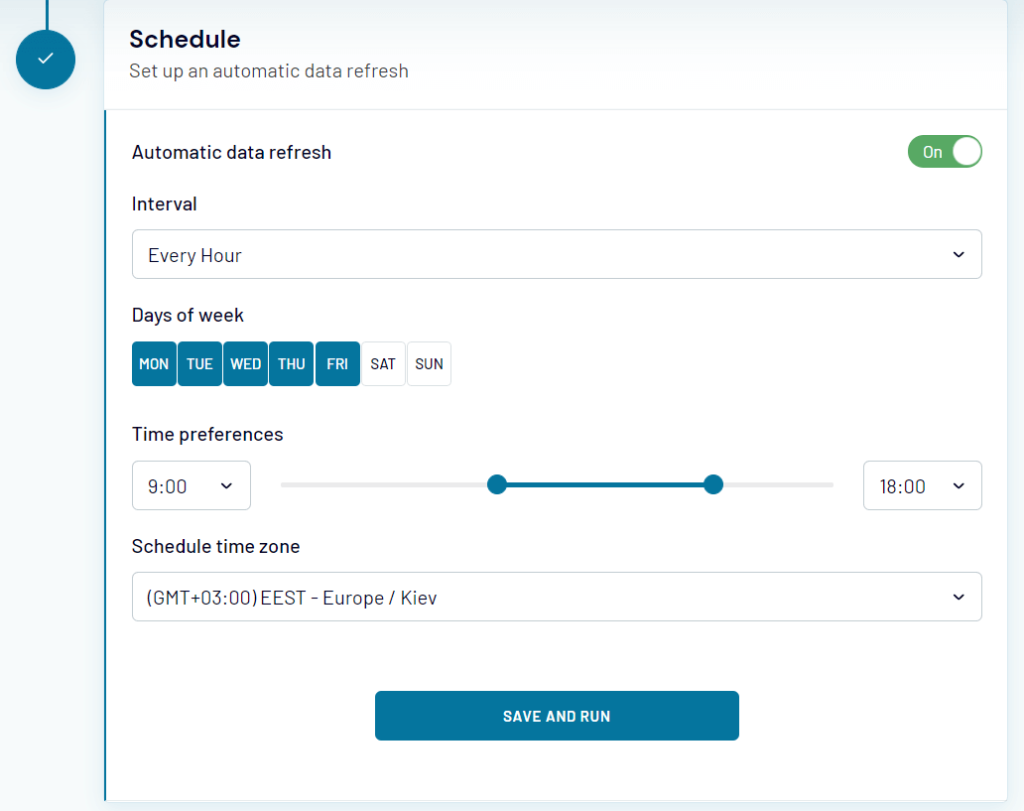
You tin can run the import correct abroad if you lot click "Save and Run". If you want to automate data import on a schedule, toggle on the Automated data refresh and customize the schedule.
Schedule
- Select Interval (from fifteen minutes to every month)
- Select Days of the week
- Select Time preferences
- Schedule Fourth dimension zone
One time you lot're ready, click Save & Run to salve the parameters and initiate the first data import and combine the specified sheets. Hither's what we've got:
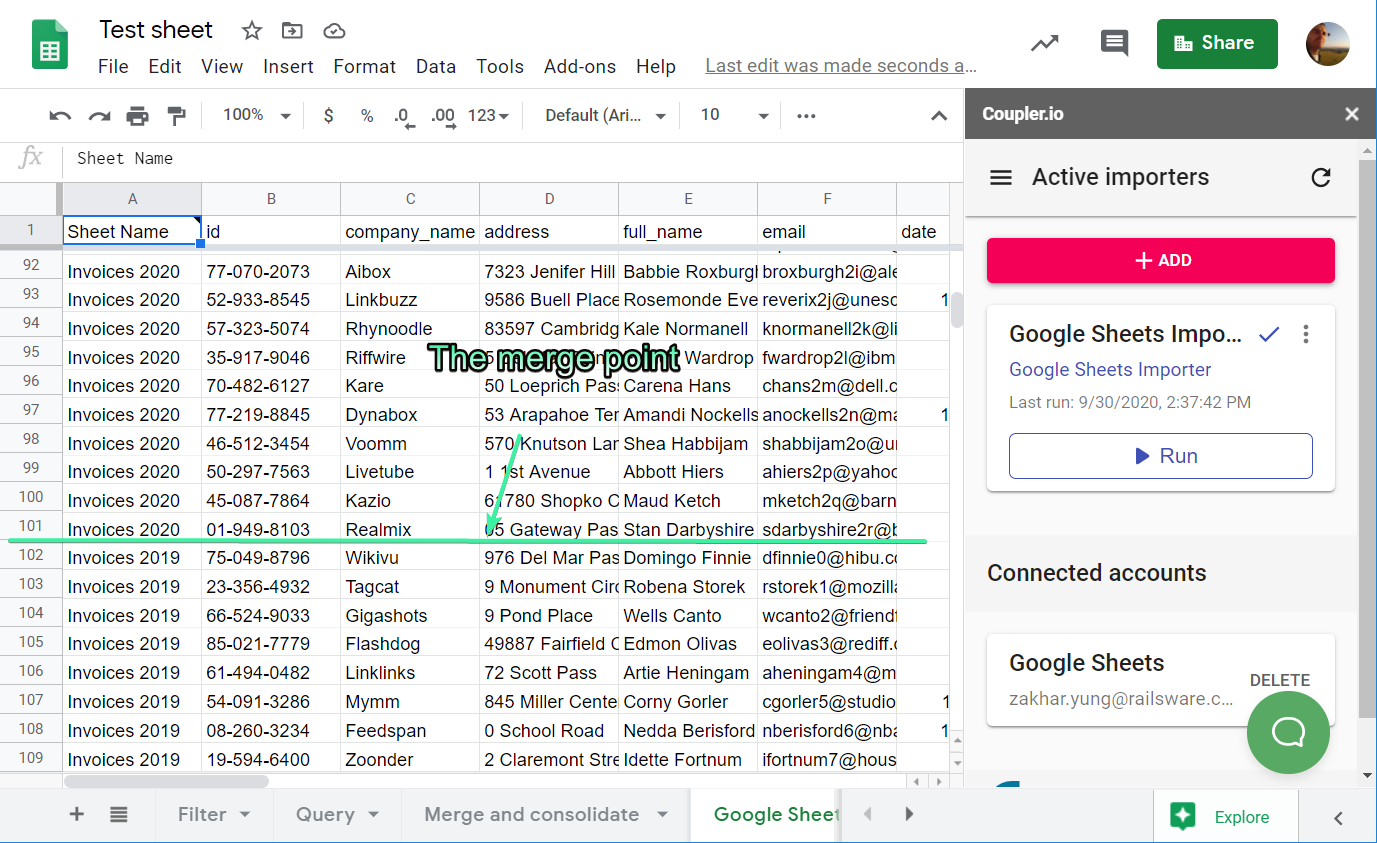
The importer adds the Sail Name column, so you tin easily navigate the merged data.
Google Sheets to Google Sheets is non the simply integration provided by Coupler.io. Information technology too allows you to import information from CSV files, Excel files, and numerous apps.
How to merge sheets from another Google Sheets doc
We already know how to combine sheets within a Google Sheets doc. At present let's explore how you can import ii or more than sheets from another spreadsheet and merge them into i. Here is the task:
I have a spreadsheet on my personal Google account, allow's proper name it External spreadsheet. I need to import and merge ii sheets (Invoices 2019 and Invoices 2020) from the spreadsheet that has been featured in the examples above. This spreadsheet is on my working Google business relationship. We'll check out all possible options, and the no-formula one will be first.
Merge sheets into one from another spreadsheet without formulas
Coupler.io and its Google Sheets importer (again) is the easiest way to import and merge information from a Google Sheets document. All you need to practise is:
- Select Google Sheets every bit a source app from the list.
- Connect your Google business relationship or choose one from the drop-down list if y'all've already continued some.
- Select a file on your Google Drive to transfer data from
- Select sheets to merge. (In our case, Invoices 2022 and Invoices 2020)

- Pick Google Sheets equally the destination application you want to salvage information to.
- Connect to your Google business relationship.
- Cull a file and a canvas to transfer the merged information to.
Now, the Google Sheets importer volition import and merge sheets smoothly.
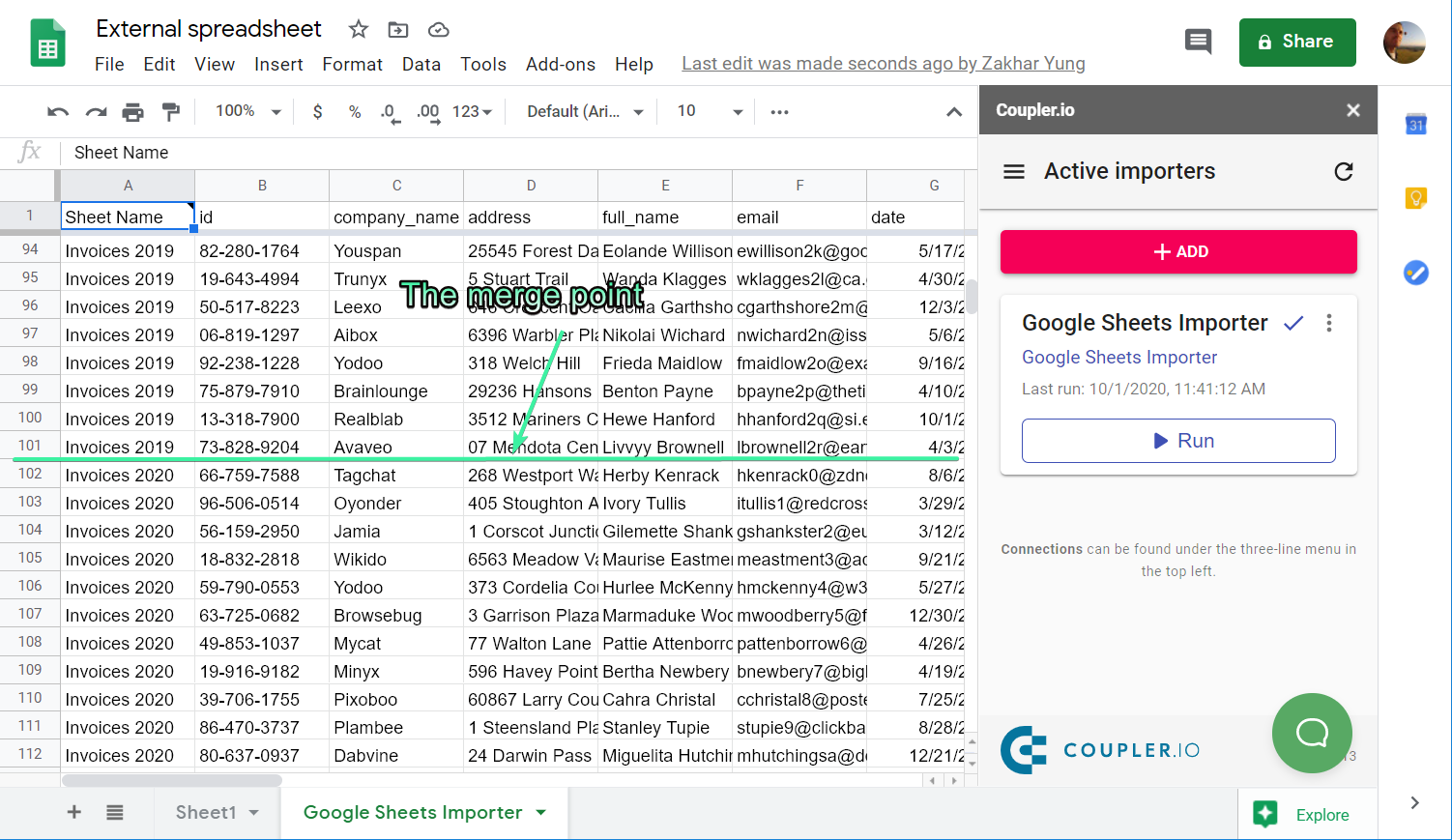
Yous tin do the same using QUERY or FILTER formulas nested with IMPORTRANGE. It is a office that allows you lot to import a data range from one Google Sheets document to another. Read the IMPORTRANGE tutorial to learn more about it.
Merge sheets from another spreadsheet into one with FILTER + IMPORTRANGE
The FILTER+IMPORTRANGE formula syntax to combine two or more sheets from another spreadsheet is the post-obit:
={FILTER(IMPORTRANGE("{spreadsheet-ID}", "{sheet#1-name}!{canvas#1-range}"),LEN(IMPORTRANGE("{spreadsheet-ID}", "{sheet#1-name}!{sail#i-first-column})>0); FILTER(IMPORTRANGE("{spreadsheet-ID}", "{sheet#2-name}!{sheet#ii-range}"),LEN(IMPORTRANGE("{spreadsheet-ID}", "{sheet#two-name}!{sail#two-outset-column})>0);...} -
{spreadsheet-ID}– the ID or URL of the Google Sheets document, y'all're importing information from -
{sail#1-name}– the proper name of the first sheet -
{sheet#1-proper name}– the proper name of the 2nd sheet -
{sheet#2-range}– the data range from the first sheet including the title row. -
{sail#ii-range}– the information range from the second sheet without the title row. -
{canvas#1-first-cavalcade}– the first cavalcade of the data range from the beginning sheet. -
{sheet#2-first-column}– the get-go column (without the title row) of the information range from the second sheet.
This is how the formula looks for our use case:
={ FILTER(importrange("1nQBbnawdY_V44lk55A3UDsdGcEQB9YR6DIpODKc94Ck", "Invoices 2019!A1:H"), LEN(importrange("1nQBbnawdY_V44lk55A3UDsdGcEQB9YR6DIpODKc94Ck", "Invoices 2019!A1:A")) > 0); FILTER(importrange("1nQBbnawdY_V44lk55A3UDsdGcEQB9YR6DIpODKc94Ck", "Invoices 2020!A2:H"), LEN(importrange("1nQBbnawdY_V44lk55A3UDsdGcEQB9YR6DIpODKc94Ck", "Invoices 2020!A2:A")) > 0) } 
Merge sheets from another spreadsheet into one with QUERY + IMPORTRANGE
The QUERY+IMPORTRANGE formula syntax to combine two or more sheets from another spreadsheet is shorter:
=QUERY({IMPORTRANGE("{spreadsheet-ID}", "{sail#one-proper name}!{canvass#1-range}");IMPORTRANGE("{spreadsheet-ID}", "{sheet#2-name}!{sheet#2-range}");...,"Select * where Col1 is non null") -
{spreadsheet-ID}– the ID or URL of the Google Sheets certificate, you're importing data from -
{sheet#ane-name}– the name of the commencement sheet -
{sail#2-name}– the name of the second sheet -
{sheet#1-range}– the data range from the first canvas including the championship row. -
{sheet#2-range}– the data range from the second sheet without the title row.
In our case, the formula will look equally follows:
=query({importrange("1nQBbnawdY_V44lk55A3UDsdGcEQB9YR6DIpODKc94Ck", "Invoices 2019!A1:H");importrange("1nQBbnawdY_V44lk55A3UDsdGcEQB9YR6DIpODKc94Ck", "Invoices 2020!A2:H")},"Select * where Col1 is not cipher") 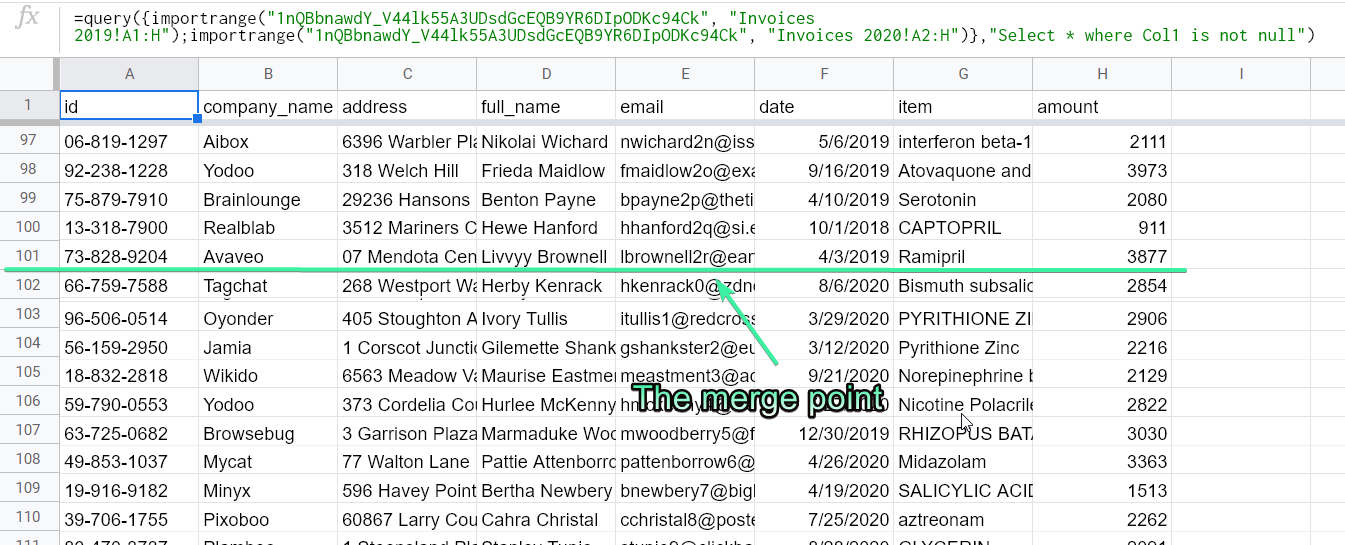
Read more than about QUERY + IMPORTRANGE combination with examples.
IMPORTRANGE #REF! Y'all need to connect these sheets

It'due south OK if you lot've got this alert during the initial run of either FILTER+IMPORTRANGE or QUERY+IMPORTRANGE formula. Click Let access to connect the source and target spreadsheets. Later that, the formula will import and merge sheets. If you've got another error, check out our weblog post Why IMPORTRANGE Is Not Working: Errors and Fixes.
How to merge sheets from different Google Sheets docs
Another use example is when you lot demand to merge a canvas from i Google Sheets medico, and a sheet from another Google Sheets dr.. You lot tin can easily handle this using either FILTER+IMPORTRANGE or QUERY+IMPORTRANGE. The difference is that you'll have to specify different spreadsheet IDs in the respective parameters of the IMPORTRANGE formula.
QUERY, FILTER or Google Sheets importer – which way to choose?
Coupler.io
If y'all don't want to waste matter time on writing formulas and checking their syntax, become with Coupler.io and its Google Sheets importer. It'southward easy to use and allows you to schedule data import & merge. The importer is particularly functional if you need to merge multiple sheets from another Google Sheets doc. In this instance, it'southward an advanced alternative to the IMPORTRANGE function.
Too, with Coupler.io, you become a listing of other importers such as Airtable, CSV, etc. This ways you can import data from unlike sources into a unmarried spreadsheet for farther processing. For example, here is how you can apply it to merge Excel sheets.
FILTER
The FILTER part is good when you lot demand to merge sheets inside a single spreadsheet. It's elementary and doesn't crave whatsoever avant-garde knowledge. At the aforementioned time, the syntax of FILTER nested with IMPORTRANGE is quite voluminous, so you'd ameliorate avoid using FILTER for merging sheets from external spreadsheets.
QUERY
The combination of QUERY and IMPORTRANGE is the best selection for merging sheets from some other spreadsheet, likewise as different spreadsheets. Its syntax is easy to cover and is not as bulky equally with FILTER.
Sure, information technology'southward upwards to you to decide which way to go, depending on what volition be all-time for your project. Good luck with your data!
Back to Blog
Access your data
in a simple format for free!Start Free
cunninghamhimpeas.blogspot.com
Source: https://blog.coupler.io/combine-sheets-into-one/
0 Response to "Read Multiple Sheets at Once Goolesheets in R"
Post a Comment